How Walkable is Your Elgin?

How walkable is your Elgin?

This past Saturday included the Winter Market and all the other Window Wonderland activities – reindeer, roasting chestnuts, holiday shopping, and more. Last year, it snowed during the festival, making it even more magical. This year, after a rainy morning (perfect for finishing my final exam of the quarter), the clouds parted, and the sun came out. So I walked to downtown, as I often do on Saturdays. I perused the Market, admired the decorated storefronts, returned some library books, got some coffee, and generally enjoyed the day before returning home about 4.

Of course, as soon as I got home. I realized that I had forgotten about the tree-lighting, scheduled for 5 PM. I’m a sucker for Christmas lights, so I headed downtown again, on foot.

Sunday morning, a friend and I had brunch plans at the Elgin Public House, and we walked. The brisk air felt good, given how miserable early December can be. While at brunch, we talked about the walkability of Elgin. I was drawn to my neighborhood by its proximity to nearly everything I need: Metra, a grocery store, library, coffee, etc. It’s a blessing not to need to dig out my sloped driveway immediately after snow hits.

And while Downtown Elgin has come a long way in the five years I’ve lived here, there are still barriers to walking. In northern Illinois, the weather can be a big drawback, of course. I wimp out when the mercury drops below 20, or when there’s too much ice for my YakTrax to safely overcome. The city does a great job clearing their part of the National Street hill, but one of the business owners doesn’t, meaning it becomes a dangerously sloped ice rink. Plus, there are certain safety issues late at night, especially walking through some poorly lit areas. I could never give up my car entirely, but 7 years without a car in Chicago trained me to shop small and walk whenever possible, habits I’m glad I’ve kept.

Downtown Elgin’s WalkScore is about 82, or “very walkable.” The site calculates a score based on proximity to transit, schools, parks and several categories of businesses, including banks, restaurants, bars, coffee shops, groceries and entertainment. The database seems to have holes in it – it’s missing Butera, the Speakeasy, and others – but it’s interesting, nonetheless.
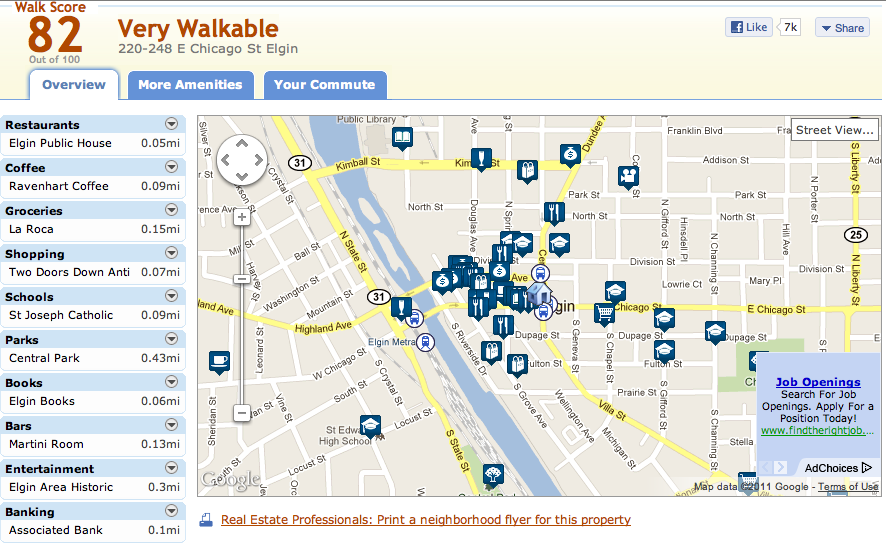
Walkability, from the center of downtown.

By contrast, New York is the “most walkable” big American city, with a score of 85. Chicago has a 73. Naperville a 74, Schaumburg 54. In each case, I input just the city name, and it calculated a score for the city center. In Elgin’s case, it appears to use the YWCA on East Chicago Street as the center point. You’ll get a different score if you put in a more specific address. My house has a score of 60.

What do you think? Is your part of Elgin walkable? What would make it more walkable? What keeps you from walking? What would encourage you?

Reverb10 Redux: Elgin Edition?

Last year, I participated in Reverb10, a web-wide blogging activity in which daily prompts urged you to look back at the year nearly done. I enjoyed it, though towards the end I felt like I was repeating myself. I had pretty much decided that I wouldn’t commit to it this year, though I’d keep an eye on the prompts and respond to the ones that intrigued me.

Yesterday, I got an email from Gwen Bell, who created Reverb10 with Kaileen Elise and Cali Harris. They’ve decided not to host Reverb this year, for reasons I understand, but which make me a bit wistful. The trio encouraged people to start their own version of Reverb11 (or whatever) and share the love.

Immediately, my mind split between two options:

1) Read last year’s prompts and re-write them, or at least for the ones that have something worth writing about.

2) Create something Elgin-centric and see if I can persuade fellow Elginites to participate. Daily might be a stretch, but maybe 5 or 6 prompts throughout the month, getting people to name/discuss their favorite aspects of Elgin? Like, “What’s your favorite Elgin holiday tradition?” or “What’s your favorite made-in-Elgin product?”

Any thoughts? If I launch the Elgin-focused option, does anyone have ideas for prompts? I finish the academic quarter next Tuesday, at which point I can exhale and take advantage of some cognitive surplus for a few weeks.

Regardless, I’m starting to mull over last year’s Dec 1 prompt: Encapsulate the year 2010 in one word. Explain why you’re choosing that word. Now, imagine it’s one year from today, what would you like the word to be that captures 2011 for you? Here’s what I said last year.

Nice & Easy: The Hot Cider Hustle

With work and school and traveling, I’ve been woefully behind in my running. I’ve only been able to squeeze in one or two short runs most weeks, and rarely more than four miles. In fact, the last time I ran 8 miles was the Chicagoland Half Marathonback in May.So I was rather nervous about last Sunday’s Hot Cider Hustle 8 Miler at Danada Forest Preserve in Wheaton.But it was great.

As we arrived... the sun popped in and out all day.

“Falling back” the night before worked out rather well, mitigating staying out too late at a friend’s (non-Guy Fawkes) bonfire. The extra hour of sleep made getting up for a morning race not-so-terrible, especially given the 9 AM start. I even woke up to a bit of daylight!

After an easy drive to Wheaton, I picked up my packet – a lovely white long-sleeved tech tee (finally! a light color!) and matching mug with the race logo. I ended up with lucky #13, which I hoped wasn’t an omen. As I returned to my car, I found my friend Ilona.

Ilona and me, with Lucky #13, before the race

We milled around before the race, stretching and trying to stay warm. We agreed we were there to enjoy the scenery and conversation, and to take it slow and easy so we could finish with smiles and without injury.

Part of the course was through open savannah, with prairie grasses as far as the eye could see

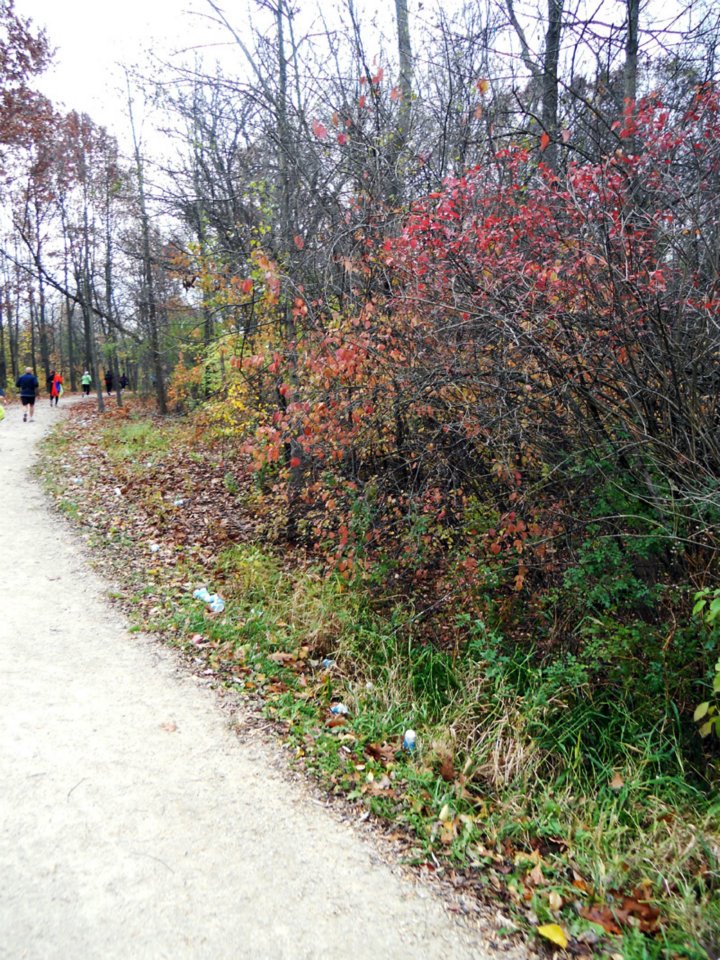
We set off on damp grass and ran the first mile or so around the equestrian loop before launching onto the crushed limestone paths of the forest preserve. It was so pretty and tranquil, even with about 500 runners. I imagine the trees would have been even more vibrant two weeks earlier before they lost many of their leaves. But it was such a great way to spend a crisp fall day, crunching through leaves and spotting hold-out leaves.

Ilona let me set the pace, as she’s been running far more lately. We ran the first five at a nice, pleasant pace, stopping only for the aid stations. Once we got moving, the weather was nearly perfect – upper 40s/low 50s, with a brisk wind that occasionally abused us. I was comfortable in long sleeves and pants.

So many vibrant colors...

When we hit mile 5 – officially, the farthest I’ve run since July – my knee was complaining, so we started walking the first tenth of every mile. The last half mile was back on the grass of the equestrian loop – tough to run on! – but I found a bit of a kick towards the finish line.

Post-race was nice – the titular hot cider awaited us, along with bagels, Gatorade, cookies, and – brilliantly – caramel apples. Ilona and I sat in the grass, stretching and chatting until we realized how cold the wind actually was.

I didn’t have big expectations for this race, and I had thought about scrapping it.  (Though I suppose I set a PR, since it was my first 8 mile race.) But I’m very glad I ran it, albeit slowly. I had a fantastic conversation with a long-lost friend and proved that 8 miles is indeed possible. And it was a great way to spend a pretty, crisp autumn day.

All smiles, and injury free!


Thanks, Ilona, for the photos, and for a fantastic day!

An Open Letter to RAM Racing

Dear RAM Racing,

Your premier event, the Hot Chocolate 5k and 15k, is next week. I did this race last year (and blogged about it, too), but I have no intentions of doing so again this year.

Several friends and I shared our dissatisfaction with you about last year’s race. From the disappointing “country’s best goodie bag” to the dangerously crowded conditions, most of us vowed we would never run another RAM event.

And yet, like a rejected, overly optimistic suitor, you keep harassing us. At first it was kind of cute – the occasional email, urging us to register early to save our spot for 2011. After a couple of those, I unsubscribed.

Strangely, though, the emails kept coming, more and more urgently. “Really, we’ve changed!” you insisted, pointing out the new course and less crowded streets. But my mind was moved up, and I had moved on.

I unsubscribed again, and again for good measure. @HeathBar6 and I tweeted to you that we had indeed unsubscribed, yet were still receiving emails, violating not just rules, but manners.

The closer we get to race day, the more desperate the communications become. I’ve gotten still more emails – why bother unsubscribing? – a postcard and, last week, a text message, urging me to hurry and register.

Each time, we tweeted our dissatisfaction with you, though I’m now vaguely intrigued to see how far it goes. And I’m not alone. A quick Twitter search yields plenty of others wondering when it will stop.

Then, on Wednesday, the icing on the cake arrived in my inbox: a “personal” email from Sara Hutchinson, your Director of Participant Experience, asking for feedback about why I hadn’t registered yet. She even kindly offered to hold a spot for me! Once again, this email has a decoy unsubscribe link that I don’t actually believe.

It sounds like RAM has fallen into the buzzword trap, hearing about the importance of the “customer experience” without actually understanding it. You talk the talk about wanting feedback and “listening” to your customers, but your actions demonstrate that really, you have a marketing plan and, by gum, you’re sticking to it. That’s insulting to customers and potential customers. Don’t pretend you’re listening to feedback and “taking it seriously” if you’re not. Don’t waste our time – or yours, for that matter.

While it’s great that you have indeed changed the course to make it less dangerous, it’s not enough. As a marketer, I won’t do business with a company who insults my intelligence or doesn’t follow the most basic rule of marketing: don’t piss off your customers. In the increasingly social world, let your customers come to you rather than ramming your message down their throats. You have a great Twitter and Facebook strategy – you can do without the text messages. Push vs pull, you know.

So thanks for holding that spot, but you can give it to someone else. I plan on doing the Hot Cider Hustle 8 Miler next weekend: smaller, more scenic, cheaper and closer to home.

Good luck with your race.

Regards,

Crysta

Making Fiction Reality: NaNoWriMo

I miss writing fiction. I’m not very good at it, but sometimes, I rather enjoy writing things that don’t require fact checking or accurate quotes. I like sketching out stories and then letting the characters lead me where they will.

I’ve done National Novel Writing Month (NaNoWriMo) twice, in 2006 and again in 2008. The goal is to write 50,000 words towards a novel in “30 days and nights of literary abandon,” with lots of motivation and misery-loves-company groups to help you get words on virtual paper. Quantity over quality, which is perfect for a first draft. It works out to 1,667 words every day, but I often wrote more when I had the time to make up for inevitable busy spells or dry periods.

In 2006, I did crank out the majority of a novel, “Commuter Shoes,” dealing with a twenty-something city dweller who buys an old house in a rather urban suburb. (Hmm… sound familiar?) Over the course of the next year, some of the things I fictionalized began coming true, which rather freaked me out.

In 2007, I was stumped for ideas, but in 2008, I tackled it again, this time writing historical fiction and doing a lot more preparation. I had an outline, characters, and major plot points. And after the 30 day sprint, I had 60,000 words, but was only in about 1955, whereas my timeline had plans for my characters until the mid-1980s. But I got busy – wrapped up in the holidays, etc, and didn’t return to it.

So I have two half-written novels, a smattering of half-baked short stories, and that’s about it.

I would love to tackle NaNoWriMo again, but I know that this is not the year. With school and work and “life” (ha!), I’m just barely hanging on to reality. While escaping to fiction would be nice, I know that I would get more frustrated at doing yet another thing that falls short of my vision.

That said, if you have the beginnings of a story in you, I highly encourage you to check out NaNoWriMo. It’s a terrific way to force you to work through your plot gremlins and start translating the ideas to paper. The online communities are great and full of motivation – and they can even help you out if you get stuck in a plot, need help with names, or just want to make sure something makes sense. And they even have local meetups throughout the area, so you can get together over coffee and share ideas or just quiet, caffeinated solace.

Even if no one ever reads it, or if you later read it and decide it’s not what you had in mind, it’s an experience that’s well worth the effort. It might turn out better than you ever expected! And November is the perfect month for it: cold and dreary enough that you spend more time inside, yet before the chaos of December or the ennui of January.

One tip: don’t edit as you write. It will frustrate you and impede the process. In fact, if I find myself trying to edit, I sometimes turn the text to white – on a white background – and write away, unencumbered by the pesky internal editor. Sara Toole Miller has more great practical advice – and a great planning calendar.

Now if you’ll excuse me, I have to write a paper about selling frozen pies.

Good luck! Ready, set, write!

Farewell, Initiate

The sign that used to greet visitors, now in a closet.

My old office closed its doors today.

Initiate Systems, founded in 1995 as Madison Information Technologies, officially ceased to exist last year when it was acquired by IBM.

I joined in 2005, asking my dad if this “customer data integration” thing had any potential. Since then, the Master Data Management market – the successor of that early CDI software – has exploded.

When I joined Initiate, I was one of about 90 employees. I sat in a cube between the offices of our CEO and CFO, and learned a lot just listening to their hallway conversations. We were most definitely a startup, with putting greens in the hallways, a foosball table in a conference room and a fridge full of free soda. We worked really hard, but we played hard, too, with extravagant All Company Meetings, Christmas parties, and more. Working with such a bright crew made everyone work harder, because we were building something better, competing against more established companies. We celebrated analyst mentions and customer wins.

Being a startup, we grew very fast, expanding office space to two additional floors. My cube moved four times, but I was always near good coworkers, occasionally within Nerf firing distance. By the time we were acquired, we were up to about 350 employees and multiple offices, but Chicago was our headquarters.

In the 18 months since acquisition, a lot has changed. Several colleagues have left for new adventures. There has been a push to work at home – which I have embraced, and enjoyed. I’ve still gone into our Madison Street office once or twice a week, ostensibly because it makes evening classes easier, but really, it’s been nice to touch base with with colleagues who have become friends. Working at home is nice, but it can get lonely. You get more done because people can’t stop by and chat, but you miss those hallway conversations.

Working for a giant company – 400,000+ employees – is cool. I just returned from our annual Information on Demand conference in Las Vegas, and marveled at how people are using our software to solve very real problems, with a huge impact. We built Watson, the Jeopardy-winning computer, that has huge potential. The IBM brand itself has cachet, and it’s nice to not have to explain who I work for.

Officially, our group is moving to a new office that’s only a block away. It’s nice enough space, with “Innovation” in its name, and it’s a block closer to the train. But I didn’t request a permanent home there, knowing that realistically, I don’t go in often enough to merit a cube of my own. I’m fine with that. I know I’ll go in periodically and see my old colleagues and maybe even meet some new ones.

But it won’t quite be the same. We worked together to build a brand that is now gone, absorbed into something bigger. I was 23 when I started working there, and I marvel at how much my life has changed, how much I’ve learned, who I’ve become. Back then, I was living in a one bedroom apartment in Wrigleyville, commuting in heels on the Brown Line, still dating my college boyfriend. I had never heard of IMC, swore I’d never work for a giant company, and couldn’t imagine living in the suburbs again.

The "Initifish" logo on a cake for our first day as IBMers, April 2010

They say you spend more of your life at work, among coworkers, than you do at home with family. I feel so very fortunate to have been part of Initiate Systems and its legacy.

So thank you, Initiate, for everything.

Growth, at a Cost

Supposedly 40-50% of the world's construction cranes were in Shanghai to prepare for Expo 2010

While traveling through Asia, I marveled at the sheer amount of growth. I hadn’t really realized it, but in the US, the last couple of years haven’t seen much construction. Store fronts empty and aren’t replaced for months on end. There’s a lot of reusing existing resources rather than building from scratch. Heck, even Habitat for Humanity is rehabbing rather than building.

In all three cities we visited – Seoul, Shanghai and Taipei – the opposite was true. Rampant growth pervaded every city, with entire blocks being recast to serve the new economy. In Seoul, there were simply no vacant store fronts – occupancy had to be nearly 100%, with new buildings growing taller and taller around the mountain-ringed city.

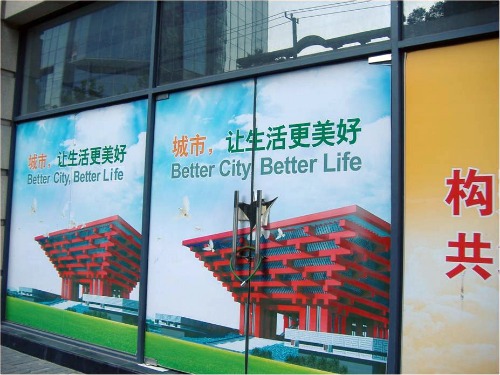
In Shanghai, growth was most obvious. The city has been on a decade-long growth spurt, in part to prepare for last year’s Expo, in part driven by a voracious economy (and yet, the growth fuels the economy itself in a vicious whirligig).

On the surface, growth is groovy. It adds a veneer of flash and new sophistication to Shanghai, helping the city meet its boasts about joining – and leading – the world economy.

Meet George Jetson... Shanghai's Pudong section, all of which is brand new

But that veneer is easily scratched, and what’s below isn’t so pretty and shiny.

China’s growth is driven entirely by the government. The central state sets aggressive GDP targets, and since it controls the means of production, it will do anything it needs to do to meet those targets. Including building where the market doesn’t demand it.

In central Shanghai, it’s not as obvious, as the city teems with more than 23 million people. But in the outskirts – and out in the provinces – thousands of sparkling new buildings sit empty in China’s increasingly famous “ghost cities.” China has vowed to build 20 new cities a year for the next 20 years, many of which now sit completely empty. The Google Earth images are eerie: perfectly developed cities with schools, hospitals, malls, and housing developments – but no cars or people.

The Pudong section of Shanghai was boggy marshland a mere decade ago, and now it looks like something out of the Jetsons. New subway lines are opening nearly yearly, some stretching out to the middle of nowhere. Construction sites bustle with activity every day of the week, importing thousands of migrants every summer who live in small shacks on the building sites.

But what’s the cost of such uncontrolled, yet centrally planned, growth? It’s certainly not sustainable, and many fear a bubble is bordering on bursting.This growth displaces thousands, even millions, of families from their homes, all in the name of progress. The Three Gorges Dam project alone destroyed 1200 villages and displaced 1.3 million people. In Shanghai, some scoff that demolishing acres of traditional homes – and replacing them with highrises few Chinese can afford – is merely finishing what the Cultural Revolution started.

Big promises. Can China deliver?

And when the rush to build meets rampant corruption and bribery, corners are cut. Some call the results “blood-stained GDP.”

40 were killed and 200 injured when two high-speed trains collided in Wenzhou in July. Just last month, two subway trains collided in Shanghai when signals failed, injuring 270.

We saw growth in all three cities, but in Shanghai, it felt the most feverish and, in a way, desperate. Desperate to prove to the world that China has arrived, eager to overcome the chip on the Chinese shoulder.

Growth is marvelous when there’s market demand for it. Construction companies stay busy and give businesses room to expand and hire additional employees to make more things that serve more people. But when the market demand wanes and you keep building, the bubble will eventually burst.

What happens then?

Welcome to Elgin! A Guide for Newbies (And Lifers)

Two sets of friends recently moved to Elgin. In the course of offering up recommendations and advice, I realized that I could probably crowd-source a much better list. So here’s my first round of advice. What advice would you give to new Elginites? Add your comments below.

The Basics

The City of Elgin website is your first resource for everything from determining your trash pick-up day to establishing water service.

Elgin has several grocery stores. Depending on where you are, you should be relatively close to one of them. Butera, right downtown on National Street at Grove, was recently renovated and has pretty good prices, though they’re only open till 10 PM. We have two Jewels – one on Summit, the other on Larkin – which are, like all Jewels, good grocery stores, albeit overpriced. I like Meijer (Randall/College Green) for my biweekly big stock-up (and late night runs). There are also multiple fresh markets, plus Klein’s Farm Stand on Lillian Street, which gets many of its veggies from a farm just outside of town.

Looking for local news? The Courier-News and Daily Herald are the two main newspapers serving town, though both are experimenting with ways to stay afloat, like charging for access. The Elginite has a good variety of topics and discussion (though be nice and identify yourself in the comments). BocaJump also has local news and opinion. All of these sites have Facebook and Twitter feeds, too.

Books & Coffee 

Gail Borden Library is fantastic. Seriously, it wins awards for awesomeness. Go get a card (free!) and use it at either branch. The main library is downtown, at Kimball and Grove, and faces the river, which makes for a wonderful reading/studying area. They always have a wide variety of events, from book clubs and public meetings to kid-focused activities. The new branch is on the west side, on Bowes west of Randall. The library publishes a biweekly e-newsletter that details all its upcoming events.

Most of the major coffee chains are represented: there is a Starbucks tucked on Randall Road by 90, in the far, far northwest corner of the city, a Caribou a little farther south on Randall, and a handful of Dunkin Donuts locations.

But go beyond those and try the non-chain options. My personal favorite is Domani Cafe on Highland. Try the Cortado (espresso and milk) when you have time to sit and enjoy it. They also have a very limited menu of very good paninis. There’s no wifi, but I consider that kind of a blessing, as I can study without interruption. Closed Sundays.

Also try Ravenheart Coffee on Chicago Street (now open evenings) and the coffee at Elgin Books (also on Chicago Street). Gail Borden Library has a coffee shop on the ground floor. Books at Sunset has some beverages to enhance your browsing. And though I often forget it’s there, I’m always happy when I remember the Country Donuts on 20, just west of Randall.

Food

So many restaurants…

The Elgin Public House and Walnut Speakeasy are two standards for a drink or a good meal. Both are great. I prefer the food at the Public House and the atmosphere at the Walnut, and the latter does have pizza. Both have extensive beer lists and terrific burgers that are half price on Mondays. The Public House also has monthly-ish tasting nights and pairing dinners.  Befriend both on Facebook for the latest specials and events.

In the Neighborhood Deli has a wide variety of sandwiches and paninis, with high-quality ingredients combined in innovative ways. And they’re really involved with the community,  helping out with numerous non-profits, schools and local events.

Toom Toom Thai (downtown) keeps expanding their menu and has a great atmosphere to go with terrific food. White Pearl (west side) isn’t quite as “pretty,” but their Thai food is excellent, with slightly larger portions. (Oddly, their website calls them a “Chinese noodle restaurant,” but I’ve only ordered Thai from them.)

Pizza? We’ve got pizza! Bocajump actually ran a contest last year (results).

As for Mexican, there are plenty of great taquerias throughout town. Everyone has their own preference, but El Faro is my default (two locations – the State Street store is open 24 hours on weekends). And their burritos are giant enough to provide breakfast the next morning, if I scramble an egg. I also really like Delicia Tropical Cafe for Puerto Rican food.

Obviously, there are dozens of other good options. Like Spanky’s Gyros for good, greasy gyros and fries. Help me out, Elginites, with your favorites below!

Things to Do

Every week, there are dozens of activities, depending on your interests. Your best bet is to keep tabs on the Downtown Neighborhood Association and sign up for their weekly newsletter, and expand from there as your interests guide you.

The Elgin Arts Showcase also maintains a trio of calendars for events at the Hemmens, the Art Showcase and other venues around town.

So that’s my beginning of a list. Hopefully we’ll build this list over time to help residents new and old alike.

Welcome to Elgin!

Street Eats

During my recent trip, the food was an integral part of the experience. And while we ate a lot of meals traditionally, at a table, we also did a lot of outdoor eating, carefully trying not to make too much of a mess.

In Seoul, we visited a couple of the big markets. In Namdaenum Market, we passed several stalls selling snacks. We avoided anything with meat – skewers of raw meat were sitting in the hot sun, unrefrigerated, waiting to be grilled to order. But the green onion crepes – thrown on the griddle to order – were tasty, and the brown sugar-filled pancakes (hoddeok) were definitely memorable and craveable.

For tourists only...

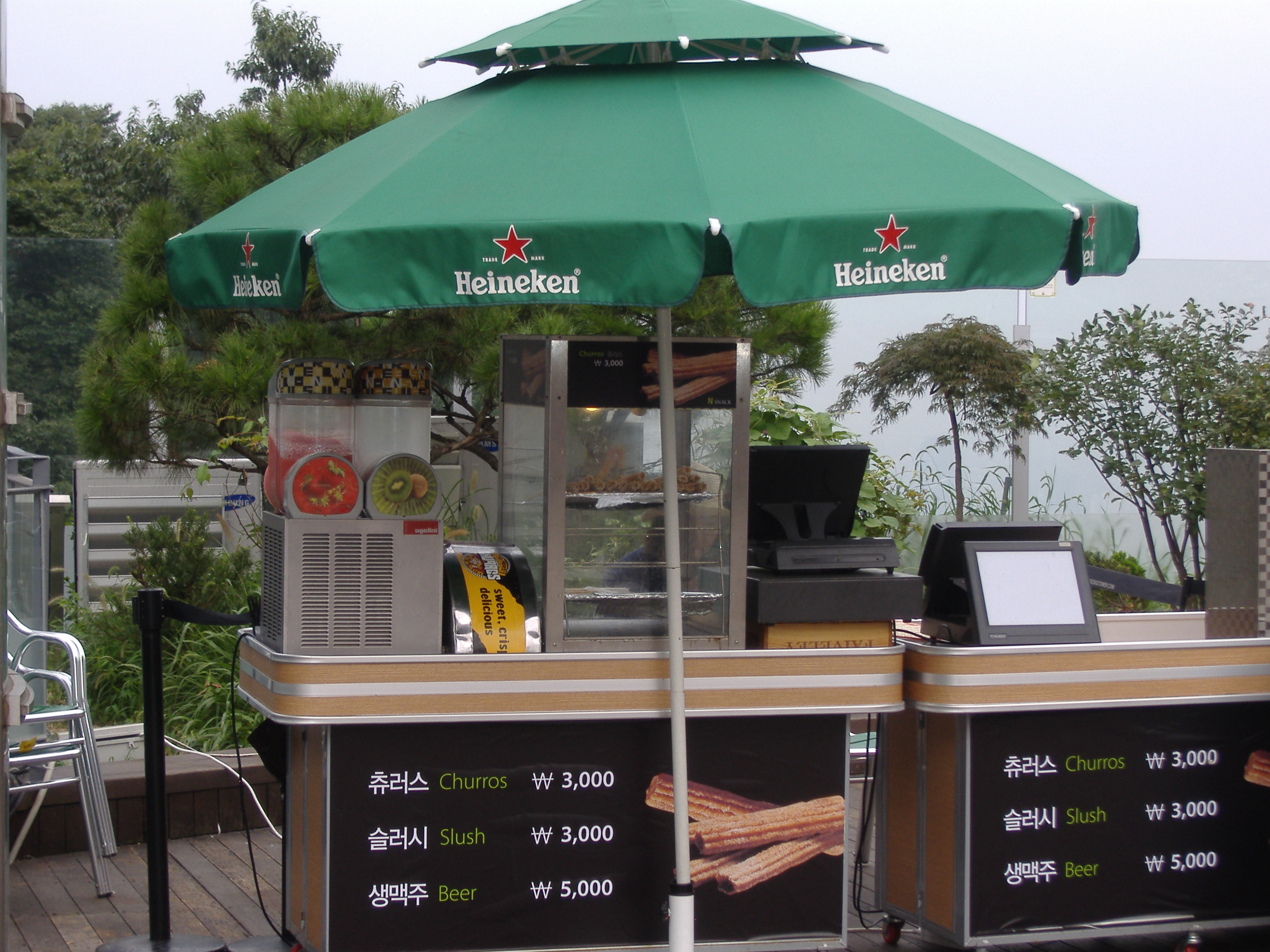
In Seoul, we also saw a very confused food cart at the N Tower, a major attraction: churros and Heineken. There was a Cold Stone directly across from this stand, too.

In China, we didn’t see nearly as much street food, other than people selling food to take home.

The markets sold everything else, though. Clothes – premade or tailored to order – of all varieties. There was an insane array of fake goods: sunglasses, purses, shoes, watches, pirated movies.

Chestnuts (or similar) and lotus roots

But food-wise, there were chickens and turtles and pig parts, fruits and vegetables and the like.

In front of the “luxury mall” on the main shopping street – where every single store, without exception, was a big name, Western brand (Prada, Hermes, Louis Vuitton, etc), people stood outside with baskets, peddling chestnuts and what I learned were lotus roots.

But Taiwan… oh, Taiwan knew how to do street food. After 5 PM, night markets spring up in several locations throughout Taipei, varying in size and specialties.

Rows of stalls served everything from bao and grilled kebabs to fish balls and waffles filled with everything from chocolate to red bean paste.

Snails.

Most things were snack-sized servings, often for less than US$1, so you could assemble a meal by trying several different things. Going with people also meant you could try more things.

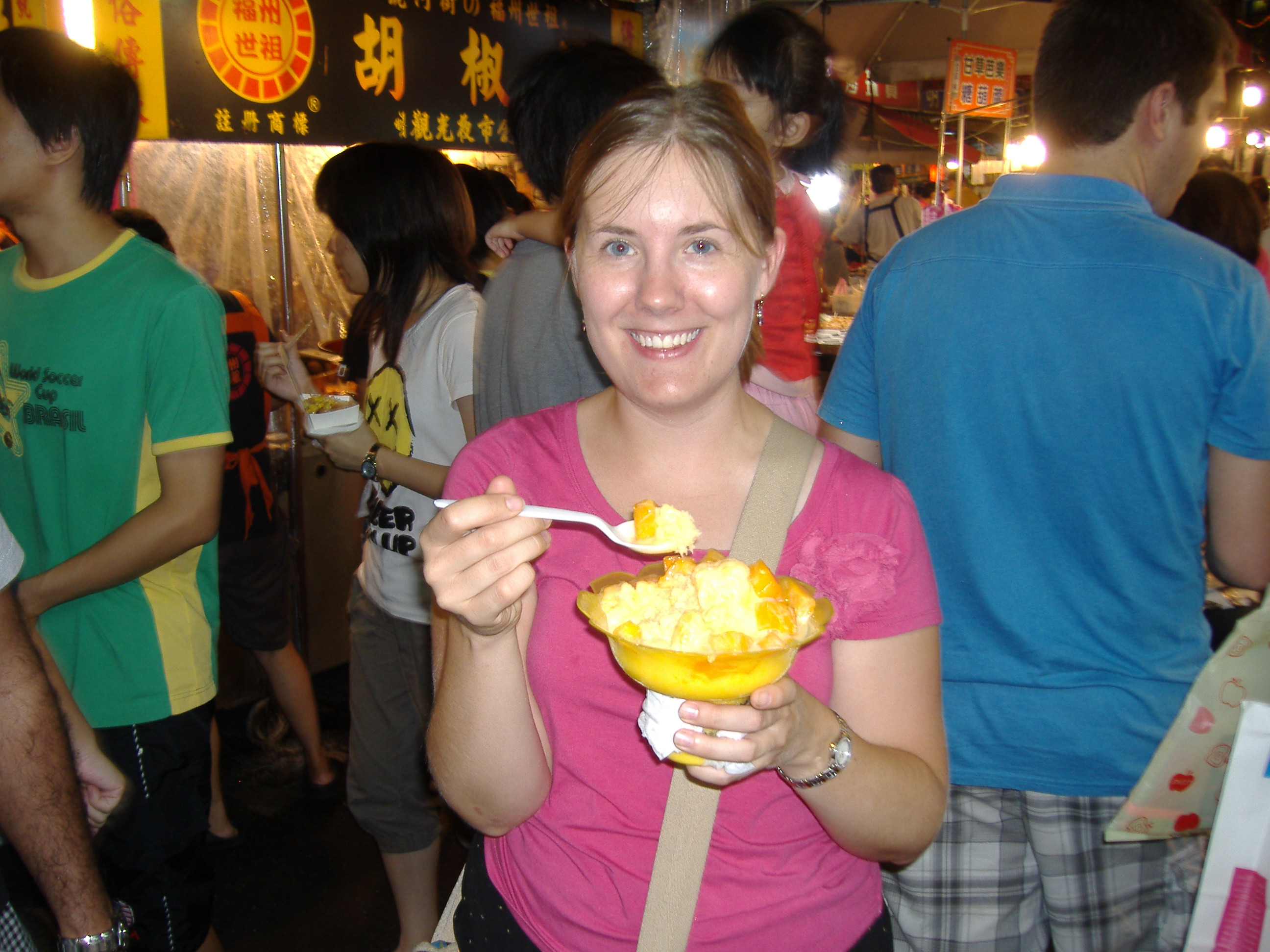
Shaved ice with mango. OMG.

And of course, you have to end the experience with a shaved ice, topped with fruit or candy and condensed milk. This mango shaved ice was incredible and giant, so I shared it with several people.

Waffles. These were filled with either chocolate or custard.

Yes, those are corndogs.

Some stalls had helpful pictures so you knew what you were eating. Other times, not so much.

The incredible thing to me about Taipei was that they do this every single night. In the US, we’re finally starting to maybe allow some food trucks, but for the most part, “street food” is a rare occurrence, tied to festivals. (And Christkindlmarket. But even that is temporary.)

Read on for more food stories.

Eating Local – Wherever “Local” May Be

Eating local is one of the best ways to understand a town, a city or a culture. In Elgin, we have lots of great local options, from In the Neighborhood Deli, where each sandwich is named for a local institution (schools, churches, etc) to the Walnut Speakeasy in my own neighborhood, which has become almost Cheers-like in its familiarity.

Lately, we’ve been reminded about how important it is to eat locally. Local restaurants don’t have the advertising dollars of their national chain competitors. Nick’s Pizza & Pub, which just announced their financial troubles stemming from a shaky economy and construction, competes against national chains who can run TV commercials or far-reaching campaigns. While social media helps build local community, it also provides an unrivaled platform for national brands to share their message nationwide. Whether your Facebook friends live in Dubuque, Albuquerque or Seattle, they know the same national brands you do.

While traveling in Asia, we talked a lot about food and its role in culture. I was bound and determined to eat as much fantastic local food as possible. And since you have to eat multiple times a day, it’s a natural way to easily experience local flavors and culture.

Good - and fun.

In Seoul, it was Korean BBQ. I went twice. The first time, my roommate, Inggrid, and I went to a place packed with locals on a Monday night,which we figured was a good sign. It was. The menu was entirely in Korean, with no pictures. Inggrid was able to use her smidgeon of Mandarin to order us a terrific meal. They bring raw beef, which you cook on the grill built into the table, using the heatlamp. Then you wrap it in lettuce leaves with a sauce, garlic, and veggies. Divine. And a lot of fun. The next night, we went to another place where the garlic- and spiced meat was even better.

Suckers!

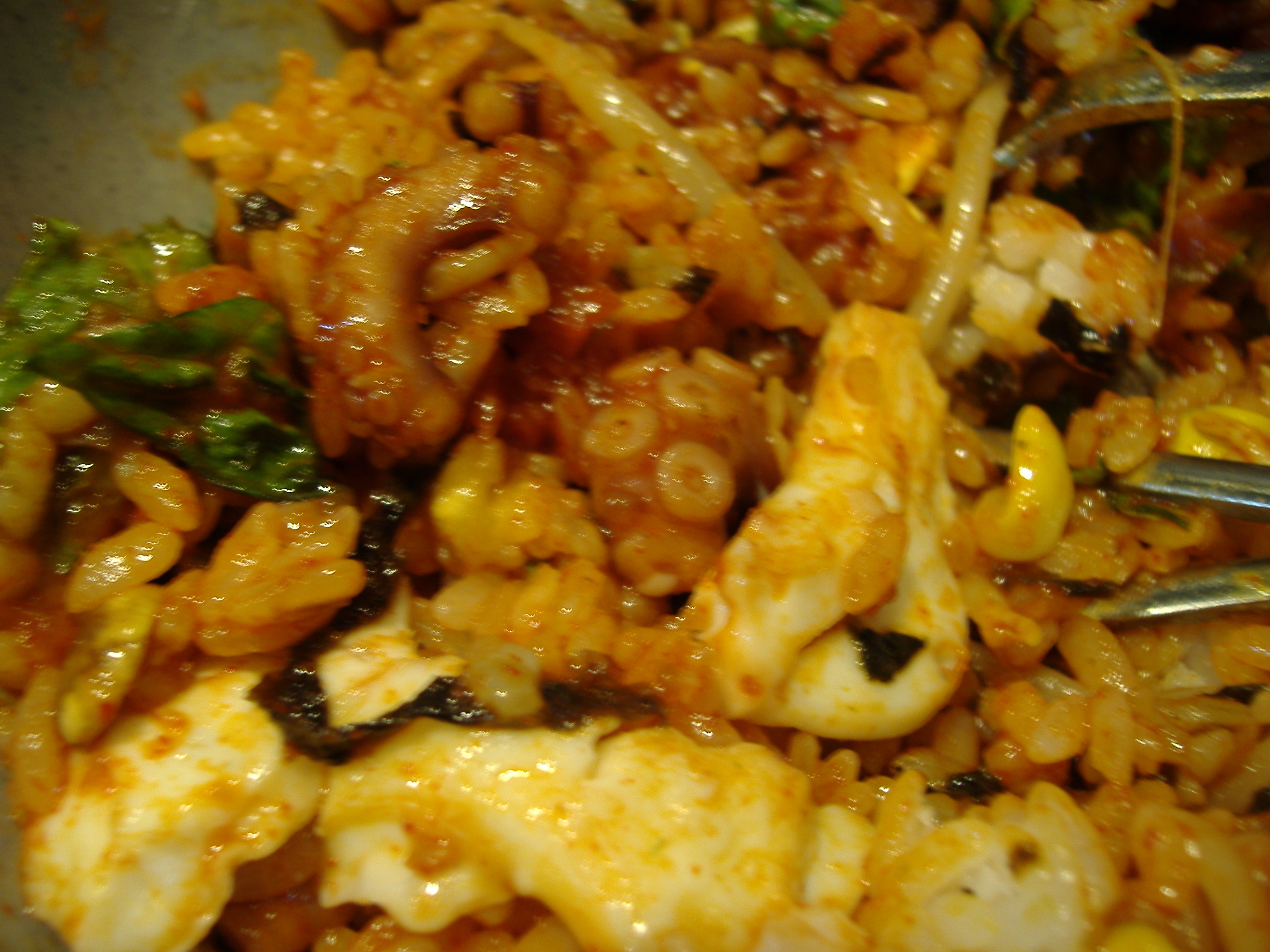
Of course, Korea was also my first “surprise” meal of the trip. One day, between meetings with marketing executives, we were given an hour to find lunch nearby. Inggrid and I took off down one of the small alleys off the main street, finding a row of restaurants with alluring aromas. We went inside and ordered by pointing and smiling. When it was served – she got chicken ginseng soup and I ordered bim bam bop – everything smelled so good. But as I stirred my lunch, I discovered tentacles and suckers! I had somehow assumed I was getting pork or chicken in my bim bam bop – not octopus. But after the initial shock, and surrounded by office workers who inhaled their lunches, I tried it. And it was actually pretty good, though a bit rubbery. I wouldn’t order octopus, but it wasn’t terrible.

In Shanghai, we saw an incredible array of food that seemed impossibly far removed from the Americanized Chinese food most of us are familiar with. We saw lots of jellied seafoods and chicken feet, and in the markets, buckets of live turtles or fish made you wonder if they were selling pets or dinner. We ate very well, though sometimes I didn’t want to know what I was eating. And it was in China that we discovered the lazy susan style of eating: absolutely everything is served family style and spun around the table to share. While this is a great way to try a lot of things, by the eighth consecutive day, you just want to order your own thing. While all the stir-fried veggies were great, and I fell in love with xiao long bao dumplings, I was really craving a big salad by the time we left.

I had no preconceived notions of what Taiwanese food would be. Every guidebook promised it would be delicious, heavy on fresh seafood, fruits and vegetables. And it was. Again, many of our meals were banquet-style, with 8-10 people at a table and a giant lazy susan spinning 10 or more courses. The shrimp and fish were so good, and so fresh, especially to a Midwest girl. The mangoes were the juiciest I’ve ever had, and we tried a “milk pineapple,” a variety only available in Taiwan with incredibly sweet white flesh. Everywhere we went, there were stands selling fresh juice – mango, watermelon, pineapple, everything, squeezed to order.

On our free evenings in Taiwan, we usually went to the night markets for dinner. Such street food merits its very own blog post.

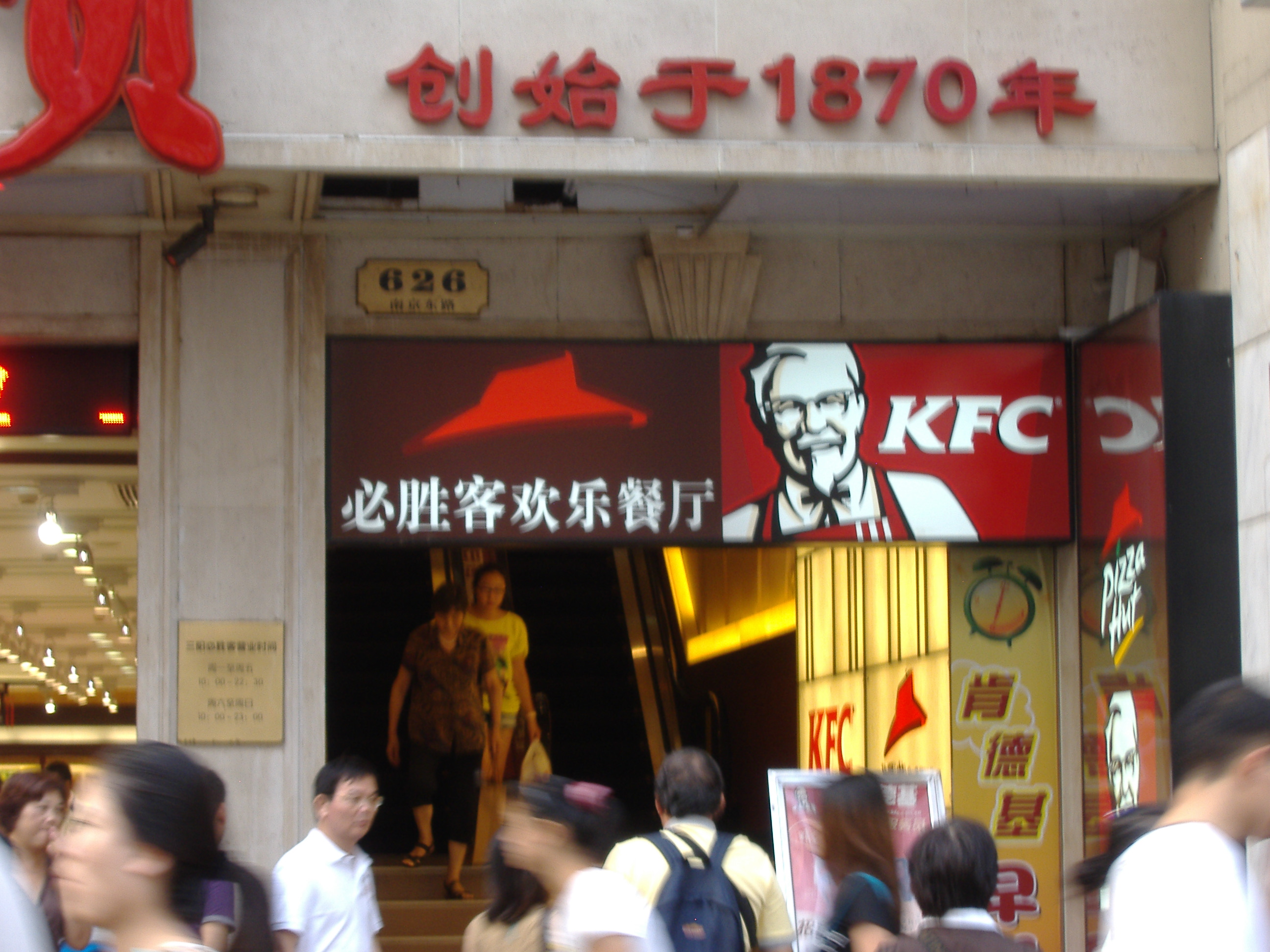
However, despite all the eating local, familiar American options abounded. KFC is extraordinarily popular in China, where they’re open 24-7 and have adapted to the local palette, serving things like congee with pork. (The day we visited Yum Brands’ headquarters, we had lunch at KFC. I felt worse that night than any other on the trip.) McDonald’s exists, but is less popular than KFC. There were a meal at Macaroni Grill our first night in Taiwan, when hunger, tiredness and frustration had us craving something familiar.

I tried to eat local, but I did often hit Starbucks in the morning, as finding a decent cup of coffee could be difficult. In fact, finding what we consider “breakfast” foods was often tough, as many Asian cultures don’t have a distinct difference between breakfast and lunch or dinner foods. So, Inggrid and I often went out for dumplings or soup. On time-pressed mornings when we had meetings with companies, I often did a quick trip to whatever coffee shop was closest to get some type of breakfast sandwich.

Overall, though, I loved my culinary adventures through Asia, suckers and all. And now that I’m home, I’m happy to get back to Domani and its fantastic coffee. Because eating local is the most familiar and comforting of all, regardless of where “local” is.

Read more about the Street Eats.