Gardening Fail

My first year of vegetable gardening didn’t go quite as planned.

I had lots of early success, but when it came to the fall harvest, I fell sadly short.

So sad... no caprese

I got a handful of tomatoes, but they never got much larger than golf balls. I left them on the vine, hoping they would grow, but most of them shriveled up and died.

I saw four small eggplants, and hoped they would keep growing, but I finally harvested them after the frost and tried to roast them, but they were just too small.

Good thing I wasn't planning on making carrot cake.

Good thing I wasn't planning on making carrot cake.

The carrots? I waited until the tops were 8 inches tall before excitedly pulling them from the ground… and got a handful scrawny little carrot bites.

The beans started off well, but I think I planted them too late, as they like the cooler weather. They wilted and scorched under the July sun.
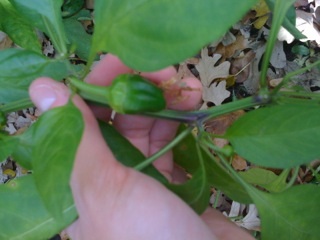
I had several peppers start, and one got a decent size before falling to the ground, where some animal got to it. (Or perhaps the critter knocked it off the vine? All I know is it was just about ready to pick one day, and on the ground with gnaw marks the next.) But the rest never got very big, despite my waiting. At the end of the season, while removing the last of the tomato cages, I found two decent sized peppers – with gnaw marks. Damn squirrels.

Anything that got much bigger than this got eaten by the local wildlife

The cucumbers and zucchini sprouts did very well on the driveway, but once I transplanted them into the ground, they really didn’t grow much. I had a couple squash blossoms, but no fruit.

Meanwhile, the cherry tomatoes and basil in planters along the driveway did very well, and the zinnias, begonias and nasturtiums out front thrived in their full sunlight.

So what did I do wrong? Plant too late? Reading labels, it sounds like I should have started these plants earlier, like late April or May, especially the cooler weather veggies like beans.

Not enough sun? I watched a couple days, and while the backyard definitely gets far more than the 0 hours of sun it used to, is 4 hours of full sun and another 1-2 of partial sun enough? The tomatoes stretched to reach the sun, but perhaps the lack of solar power stunted their growth.

Do I need to do more than just water and weed? Should I fertilize? Mulch? Use Miracle Gro?

So, gardening friends – help me out. Alternatively – does anyone have a good local CSA they recommend for next season?

Must Everything Go?

This morning, I attended my first estate auction, held at a house just a few blocks away. Built in the 1880s, the house has been vacant since its owner, Bernice, died 7 or 8 years ago. She had grown up in that house, then married and lived there with her husband. They had no children, so after she passed away, it sat, full of antiques and a lifetime’s worth of accumulated stuff.

The online advertisement talked of how rare it is to find a house with its contents so intact, and surveying the rows and rows of tables filled with everything from beautiful antique furniture to the minutiae of life – pots and pans, tablecloths, Christmas ornaments – made me kind of sad.

It took only three hours to auction off an entire lifetime of things. Each of those items had a story behind it, and I’m sure Bernice could have told you that the large platter was a Christmas present from her husband or she wore that broach to her best friend’s wedding. Maybe the books and books of stamps, so lovingly collected over the years, were a hobby shared with her husband. Did she receive the china as a wedding gift?

Even sadder were the photographs. Those were auctioned off in lots, and when interest waned, they started combining boxes, so three boxes of assorted family photographs – for a family whose line has ended – were going for a bid of $10. There was a pair of old photographs of the house itself, dated 1887, that should have stayed with the house, but instead they were bought and carted away.

I know that, with no heirs to speak up for the items, an auction is the logical way to dispose of it all. But I wonder if Bernice could have ever thought that the entire box of mementoes from her career at the Elgin National Watch Company would fetch just $20 from a stranger some 30 years later. And when I got home, and surveyed the items I’ve collected in my travels, I wonder if the silver Turkish coffee set I haggled for in Istanbul or the hand-painted clay puppets from Greece will some day be part of a similar auction.

I never raised my bid card, though I wish I would have on the Lady Elgin pendant watch, gold-filled, that went for $25. And the green Depression glassware was so pretty, but I had no real use for it. A friend won a couple lots of quilts and goofus glass, and gave me a pair of Japanese plates that had been thrown in. They’ll look nice in my built-in china cabinet.

Overall, it was an interesting morning, standing in the pouring rain under umbrellas, watching an entire houseful of items be inspected and carried off. (The mimosas and hot coffee definitely added some joviality to the affair.) I think I’ll go to more auctions in town, if even just to see the old photos of Elgin as it used to be. And maybe I’ll find a watch, or a photo of my house, perched up on the bluff.


Night Owls: Riding the Late Train

Since I’ve started grad school, I’m taking a late train home two nights a week. These trains are a completely different experience than the usual 5:17 express train. Depending on whether I go out with classmates for a drink (which happens the occasional Thursday) or go straight to the train translates to a completely different cast of characters.

Earlier Late Train

Mostly work- and class- weary riders: Overall, this train is pretty quiet, with many people coming from grad classes. These are mostly professionals who look tired. They tend to either zone out with ear phones or frantically work on their laptops, catching up on either work or school, a glazed look on their face.

Drunk middle-aged dude: More common on Thursday nights, there’s inevitably one overly chatty, drunk middle aged guy in a leather jacket, trying to act 15 years younger than he actually is. He chats up the conductors and tries to flirt with some of the women. He tends to slur his words. Often he makes a quick call to a wife, asking her to come pick him up from the station.

Giggling Teenage Girls: I don’t know how high school age girls always manage to be on this train, but maybe they’re actually college freshman. Regardless, there tends to be a group of 5-8 giggling, shrieking girls, taking pictures of each other, texting each other, and excited that they just spent the day in the big city. (These are likely the same people who walk five abreast down the sidewalk at rush hour.) Try to avoid the car they’re sitting in.

Loud Talker: Every train has at least one person who shouts their end of a long, inane, deeply personal cell phone conversation. This is more often a woman, but men are guilty, too. When they start rattling off credit card numbers, I wonder who else is listening.

McDonald’s Eaters: After 7 PM, the closest thing to food at Union Station is McDonald’s. (Unless it’s closed, which has happened twice recently, leaving your late night dining options Mrs. Fields cookies or beer.) I think I’ve finally figured out when to eat what so I’m not ravenous as I hit the train, but inevitably, there’s at least one person who boards with a bag of fresh, hot McDonald’s fries.

Later Train

The later train has all of the above groups, but they tend to be rowdier. There are more drunks and gigglers, and fewer students and office workers. During baseball season, there are also hoards of very drunk sports fans. There’s also usually at least one very annoyed single mom with a gaggle of young children who are cranky at the late hour. She usually either lacks patience for them and yells at them to sit still and shut up, or she ignores them entirely while she talks on the phone.

The later train is worse in many ways because it only has two cars open (versus three on the earlier late train), so there’s less room to hide.

What other characters have you seen on the late night trains?

Cold Morning for Hot Chocolate

Last Saturday, I ran the Hot Chocolate 15k along Chicago’s lakefront. It was my first 15k, my first race in Chicago proper, and my first “big” race.

It was cold. The start-time temperature was just 26 degrees. I spent Friday night debating which layers to wear so I could easily adjust as I warmed up. I ended up wearing warm-up pants, a long sleeved UnderArmour, a t-shirt, and my new Moeben sleeves over the top. The sleeves worked well, as I was able to roll them up once I got warm and then pull them back down as we turned into wind. I also had cheap Magic Gloves for the start which I ended up stuffing into my pack after about 3 miles.

Overall, I’m glad I did this race. It was touted as having the “best goodie bag in the country,” which I find a very generous stretch (see Cate’s post for more on that), but really, the distance intrigued me. The odd 15k distance seemed a perfect goal.

The race had far too many people – 30,000 registered, with about half each doing the 15k and 5k. Several friends said the lack of a “wave” or staggered start caused the terrible bottlenecks that plagued the narrow course. I couldn’t even get into a corral until just moments before the start. But at least I ended up in the right area, the 10 minute mile section. There were several people who couldn’t get where they belonged (or were delusional about their pace – many who started near me were walking a mile in), which worsened the bottlenecks.

There were times it felt downright dangerous. At several points, the entire mob screeched to a stop as the path narrowed and there was simply no place to go. My heels were stepped on and elbows flew as people tried to advance. I saw one woman fall at the 2 mile marker, nearly trampled by the horde, and there were several other close calls.

The advantage was that I never got very much speed, so I was able to run the entire thing, except through the narrow aid stations. Prior to the race, I had only one training run over 9 miles, which had taken 1:50 and several short walk breaks. Officially, I finished in 1:40:41. (My Garmin had me at 1:38:03, but that’s suspicious, since it had mile 2 as 8:21 – which would have been the fastest mile I have EVER run. Doubtful given the crowd and the aid station. That mile also happened to be partially under McCormick Place, where I lost signal – I’m betting the Garmin paused while underground.) I had told myself no walking until mile 7, so I was pleased.

Going south along Lake Shore Drive was relatively uneventful, but coming back north was gorgeous, with the whole skyline spread out before us in the early morning sunshine. I see the skyline several times a week during my commute, but seeing it from the south, with the lake, was beautiful and reminded me of undergrad picnics at Promontary Point. The stretch of large, ankle-twisting rocks was tough, very different than the crushed gravel I’ve trained on. Throughout, several people ran along the grassy sidelines so they could pass, but I was worried about the uneven ground with my still slightly wonky ankle. I stuck to the middle of the path where there were relatively few walkers. I kept picking out people ahead to pass.

The end was freeing, as the course finally widened to the entire width of Columbus Drive and I was able to sprint hard to the end. Once across the line, I wandered as people handed bottled water and Gatorade. (I usually hate Gatorade, but by the third aid station, it tasted fantastically refreshing, likely because it was ice cold.) Once I found the fondue, hot chocolate and my friends, it was great sharing stories.

I’m glad I did the race to prove to myself I can do 15k before I attempt the Indy Mini Half Marathon in May. (I’m still wary of winter training.) But I doubt I will do this race again due to the crowds and congestion.

Splits: 1 – 10:18; 2 – 8:21 (um?? especially with an aid station?); 3 – 10:37; 4 – 10:55 (aid station); 5 – 10:54; 6 – 11:05 (aid station); 7 – 10:45; 8 – 10:55; 9 – 10:27 (aid station); 0.39 – 3:40 (9:20 pace)

Tastes Like Fall

As the days turn colder and darkness creeps in earlier, I’m finding comfort in cooking comfort foods. I’m really starting to enjoy the soothing ritual of taking a pile of fresh ingredients and turning them into dinner (and two or three lunches, and another dinner). Plus, in the hectic whirl of work, classes, neighborhood commitments and more, it’s nice to be able to eat real food, and not live on canned soup, cereal and frozen food.

Here are some of my recent favorites:

Turkey Pumpkin Chili – Is there any better fall food than a simmering pot of chili? I love chili and adore pumpkin, so when I stumbled onto this Whole Foods recipe on Twitter a few weeks ago, I had to try it. And it was divine. The pumpkin added a hint of sweetness and a creamy texture. I cut back on the jalapenos and chili powder, since I don’t like heat, and added more tomatoes instead of the beans. I devoured the results over the following days, and I’m very glad I stashed a couple servings in the freezer.

Pumpkin Cranberry Bread – After I made the chili, I had half a can of pumpkin left, so bread made sense. I’ve been eating more whole grains, so I searched until I found a recipe that didn’t involve  the more exotic flours. Instead of chocolate chips, I spiked my loaf with Craisins. Yum. Although I did learn that I really shouldn’t make bread like this if I’m planning to work from home.

Roasted Chicken, Fennel and Parsnips – I bought parsnips and fennel because they seem like fall vegetables, and I’m trying to branch out. Monday night,  my stomach was growling and I had no dinner ideas, nor a lot of time as I had a paper to finish. I opened the fridge and saw the fennel, parsnips and a random package of chicken thighs. I flipped through my Bittman bible and found a simple recipe that combined the three. Essentially, you thinly slice the fennel and parsnips (I added carrots for some color) and roast them in olive oil at 450 for 10 minutes. Next layer the chicken (with sea salt and ground pepper) over the veggies. Roast everything together for about 30 minutes, periodically spooning the pan juices over the chicken, until the chicken is cooked through. The house smelled fantastic, and this really tasted like fall, with warm, rich flavors. I garnished with fresh parsley and the fronds from the fennel bulbs. I think this would be great with eggplant, too.

Butternut Squash Tacos – This recipe on Jenn’s fantastic blog intrigued me – squash as a basis for tacos? – but I’m so glad I took the plunge. The squash and caramelized onions are just a bit sweet, and the chipotle puree adds definite kick. (Again, I reduced the amount of heat.) And Butera carries several varieties of cotija cheese, which I’m now adding to everything from eggs to chili.

Granola Bars – One of the oddest transitions to school has been figuring out when (and what) to eat so I’m alert during class but not ravenously hungry late at night. In the old days, on a “typical” weekday, I would eat lunch at noon and dinner about 8, with a substantial snack around 3:30 or 4 that fueled my evening workout. But when I have class, I have to eat dinner at 5 – or after class at 9, or not until I get home at 11. Ugh. Enter granola bars. I had always heard they’re not hard to make, so I tried Jenn’s recipe (seriously, her blog will teach you how to cook!). I will never again buy a commercially made version! I used dried cherries, walnuts and almonds in my first iteration, but I will surely try other combinations. These provide just enough fuel so I’m not gnawing my arm off by the time I get home.

I have a whole pile of other things to try. What have you been cooking lately? What tastes most like fall to you?

Race Report: Sycamore Pumpkin Run

I ran my very first 10k last weekend, the Sycamore Pumpkin Run. Friday night, while out for what was supposed to be a four or five mile run, I turned my ankle wrong avoiding a gate that suddenly opened in front of me. I sprained the same ankle three years ago, and ever since, it’s been somewhat balky. So after limping home, I popped some ibuprofen, grabbed a bag of frozen peas and propped it on a pillow for the rest of the night. I spent much of Saturday doing the same thing, staying off it as much as possible.

Sunday morning, it felt ok. Not great – very stiff, with a dull ache – but not the throbbing pain that kept me awake Friday night. I took more ibuprofen with my PBJ oatmeal and debated what to wear. It was a chilly 31 degrees. I didn’t want a repeat of the Harvest Hustle where I roasted in the 40 degree chill. I went with a short sleeve technical tee and long warm up pants, with a cotton hoodie that I planned to leave in the car. (I still need to get a non-cotton zip up hoodie, and dig out my non-leather gloves, but I ran out of time.) I downed my second cup of coffee and set off for Sycamore, about 45 minutes west of Elgin.

Once I found the place (thanks, Google Maps, for sending me down a dirt road!) and parked, I jogged to the Armory to pick up my shirt and bib. I could see my breath and second guessed whether I would be able to ditch the hoodie as planned. I then broke what I’ve heard is a “rule” of races – I stripped off my tee and put on the long sleeve technical shirt with the race logo.

I met up with some Daily Mile friends, including the fantastic Beth. We lined up around the 9:30 mile pace sign, waited for the gun and took off. Beth was dressed as Super Pumpkin, complete with cape and mask, which made her easy to spot once she got ahead of me after the first crowded mile or so. There were several cool costumes, from various winged fairies and princesses to a squirrel, a chicken and Santa Claus.

Beth, Crysta and Michael, all Daily Milers

The first mile through quaint downtown Sycamore, I concentrated on keeping a moderate pace. I’m often guilty of going out too fast, leaving nothing for the end of the race. Plus, I didn’t want to overtax the ankle too soon.

Miles two and three were cold, straight down a country road flanked by a subdivision on one side and a farm with grazing cows on the other. There was a crisp breeze through this stretch, especially as the pack thinned out. I focused on keeping a pace around 9:30 and ran along the white line, listening to bits of conversation around me.

Mile four, we turned out of the wind onto another country road. I stopped for water and the ankle complained a bit. I walked a few steps while sipping, then kicked it back into gear. At mile 5, I realized that, if my math was right, I could meet my original “under 60 minutes” goal if I really pushed, so I took off with a pace around 8:30. Unfortunately, this only lasted about half a mile before I couldn’t maintain it, so I slowed down as the crowd surged around me. I felt like I was going to puke as I followed the curving paths through the golf course. I didn’t see the actual finish line until I was right on top of it (damn curves!), but I kept eying my watch, knowing that I was going to be very close.

I really hoped I hit "stop" at the right instant.

And it was. I crossed the line as the clock said 1:00:31. As I hit “Stop” on my watch, it read 59:59. I knew I was about 30 seconds behind the clock time (thank goodness for timing chips!), so I met up with Beth, got a beer, watched the other runners come in… and then went to look for results. Officially? I finished in 59:56. Woo-hoo! Not bad for a first 10k, especially on a less-than-healthy ankle.

Next weekend is the Hot Chocolate 15k. I plan to rest the ankle as much as I can through the early part of the week. I’m not sure what a good goal is yet. Under 100 minutes?

Tingly Toes – Or, Goodbye Heels

I just assumed I’d spend all my adult years wearing heels. After all, I’m not that tall, and that’s what women do, right?

Over time, I’ve built up quite a collection of “grown-up” shoes, in colors from black and pink to red and lime green. When I lived in Chicago proper, I wore stilettos for my standing commute on the El, walking blocks, sometimes miles, in heels and never thinking twice.

Since then, I’ve lived my theory of commuter shoes, which stipulates that the easier the commute, the more comfortable the shoes. I typically wear a relatively comfy pair of atheleisure shoes or sneakers for my commute, then switch at the office.

But this fall, I’ve encountered a couple big obstacles.

First, now that I’ve started grad school, my work bag is stuffed beyond capacity. By the time I haul my laptop, giant packet of readings, lunch and dinner, travel mug and notebook, I have no room left for leisure reading material (not that I have time for such a thing!) or shoes. And in my own vanity, I don’t want to wear the ugly commuter shoes to class. So I’ve been stupidly wearing pretty shoes for walking to the train, to the office, around all day, to class, to Union Station, and finally up the hill to home.

Second, now that I’m running, my feet just can’t take the heels anymore. This week made that especially apparent. After an eight-mile run last Saturday, I developed a small blister on my toe, and my feet were sore. Fair enough. Then Tuesday, I wore relatively low heels all day, including to/from the off-site meeting a few blocks away. Normally, this wouldn’t be any big deal. But the combination of already-sore feet, a blister, and more walking than I intended left me limping by the time I got off the train late Tuesday night.

Wednesday, I woke up with feet that were downright numb. They screamed as soon as I put weight on them. The numbness persisted through a five mile run that evening, all day Thursday, and finally began to ease a bit by mid-day Friday – just in time for today’s long run.

A couple years ago, I sprained my ankle and had to go out and buy flats. I wore those two pairs daily for about three months, then returned to heels. I’ve been wearing those two pairs again (and again) and think it’s time to expand my collection.

Plus, even my old shoes – the ones I’ve worn faithfully for years – suddenly cause problems. They almost feel too small – as if my feet have grown since I started running.

I won’t swear off heels entirely. Sometimes I like the boost of height, and for special occasions, they just seem right. (And what if I meet a really tall guy?) But I’ll start treating my feet – and myself – better.

Besides, thanks in part to running, I feel taller than ever before. So goodbye, heels. It’s been fun.

Doing the (Hilly) Hustle 7k

I love running local races because it’s cool to realize just how many runners are nearby – though I always wonder why I never see any while I’m out.

Saturday’s South Elgin Harvest Hustle 7k intrigued me because the start line was less than three miles from my house. Plus, the 7k distance is good preparation for the Sycamore Pumpkin Run 10k I’m running on Halloween. According to the website, the course had “challenging hills.”

Even on Friday night, the forecast was flirting with Saturday morning showers, so I told my running buddy it would be a game time decision – after a long week, I wasn’t digging a cold, windy, wet run. Rain woke me at 5 AM but it had stopped by the time I got up. As dawn broke, the clouds parted and it turned sunny, but the strong winds out of the N-NW made the start-time windchill a brisk 41 degrees. I haven’t run in the cold yet, so I grabbed a cotton zip-up hoodie and dug through my cold weather gear bin for gloves, but could find only one that wasn’t leather or turquoise suede (when did I buy THOSE?!?).

Some people were wrapped in blankets with mittens while others wore shorts and sleeveless shirts. I secured my bib across my hoodie, using extra pins so the wind wouldn’t whip it around. I washed my hands with the water outside a port-a-john, and my fingers froze instantly – apparently that water had been sitting outside all night. Refreshing!

I heard people grumbling about the hills as we lined up at the base of one. Great, I thought, craning my neck to look up, it’s a nasty one, but we’ll get it out of the way at the start. I stretched a bunch and jogged around, trying to warm my muscles.

The gun went off with little warning and we slogged our way up the first giant hill. After that it gets blurry. I know there were at least five big hills, possibly six. It seemed like we never went downhill, though. A girl running next to me at one point asked how this was possible – the organizers had found a route with (what seemed like) six uphills but only two downhills.

At my last couple 5ks I’ve bolted far too quickly from the start, finishing my first mile around 8:40, but then lacked juice at the end to manage any sort of sprint. I held back a bit this race, in part forced to do so by the hills, and my first mile came in at about 9:13 – still faster than my typical mile, but not as extreme. The cold, dry, ragweed-filled air was really tough to breathe, so I grabbed water at the aid stations at 1.5 and 3.5 miles. (I skipped the 2.5 mile station which was at the mid-point of an uphill. Most people seemed to run right past that one!)

I did walk for two short spurts. At first, my legs were stiff and cold and just couldn’t make it up the third (or was it fourth?) hill. By mile three or so, I was absolutely roasting, but I had pinned my bib very securely across my hoodie, bridging the zipper. I could unzip it, but my numb fingers couldn’t work the safety pins to reposition the bib, and the hoodie was snug enough I couldn’t get it over my head. I tried rolling up the sleeves but that didn’t really work, either. I really need to learn how to layer for colder days and get a good technical sweatshirt.

Most of the race was through residential areas, and several houses had been freshly tp’d before the rain, so there were people out cleaning who cheered us on. In general, I was surprised by the number of spectators, all of whom were very enthusiastic. A few were on bike and cheered at a couple different places along the route. Even some of the cops blocking off streets were yelling encouragement as the runners passed.

The wind was blessedly at our backs most of the last mile, until we turned and ran back down the giant hill we started from. I kicked it into gear and passed two people, which felt great. I need to remember that feeling so I don’t start too fast again!

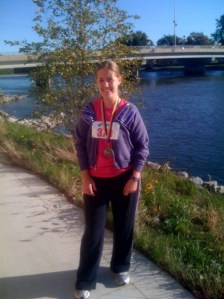
I finished at 43:02, a 9:55 pace. I didn’t know what to expect for a 7k, so my unofficial goal for a “challenging” but unknown course was sub-45 minutes. As soon as you crossed the line (and they ripped off the bottom of your bib), the organizer shook your hand and gave you a medal. It’s my very first medal, and even though it’s generic, with no race name, date or anything on it, I grinned when I put it on. I finished 39th out of 76 in my “division.” They only  had two divisions for each gender: Under 15 and 15 and up, which seems odd. The winner finished in a blazing 24:57 – a pace of 5:45. Incredible!

The post-race was nicely done, with small Chinese take-out boxes next to bins of trail mix ingredients, so I mixed together granola, raisins, dried cranberries, chocolate chips and almonds. Great, healthy post-run snack! There was plenty of piping hot coffee and hot chocolate too. We wandered by the river and watched the crazy people fishing in knee-deep water, and chatted with other runners.

Overall, a very tough course, but I would do this race again – and maybe break 40 minutes.

Splits: (Approx; from memory as I passed each stop-watch carrying person):
Mile 1: 9:13
Mile 2: 9:25
Mile 3: 10:56
Mile 4: No idea – There was no sign, just some woman with a stopwatch, and I didn’t realize she was the mile marker until I had passed her.

Squelching the Lizard Brain

A couple weeks ago (my, how time flies!) I had the distinct pleasure of seeing Seth Godin speak at the Harris Theatre.

I’ll admit I wasn’t all that familiar with Godin prior to this session. I knew who he was, and I’d bits of Tribes and Linchpin. I thought I knew some of his basic concepts. He’s the guy who talks about innovation and marketing, right?

I was blown away.

The timing was perfect, just days before I began my graduate program in integrated marketing communications. Godin does talk a lot about how marketing has evolved and how the rules have changed. But really, it’s so much more than that. It’s a complete shift in mindset.

Technology has completely revolutionized the very core of our society. We now own the means of publication and promotion, of ideas.

So why are we wasting it on following processes and procedures, policies and pabulum? True revolution and change doesn’t reward such compliance. Instead, we are at our best when we accept challenges and take risks.

Godin talked extensively about the “lizard brain,” the evolutionary holdover that controls our most primal emotions: fear, anger, revenge and reproduction. The lizard brain is that voice that tells you something’s too hard, or too out-of-the-ordinary, or too daring. Godin essentially advised using the lizard brain as a sort of compass – and then doing the opposite. When something seems scary, embrace it and do it.

So how do you trick your primal lizard brain? Godin advised to play by its rules and schedule time into your day – the lizard brain embraces such structure and scheduling – but use that time to start with a blank sheet of paper and work out ideas.

Of course, they won’t all be winners. For every good idea, there are dozens, scores, hundreds of bad ones! (We talked about this in class the other night – how about Maxwell House ready-to-drink coffee – just heat and serve – or Frito Lay Lemonade?)

But he’s right about the blank sheet of paper. For years – since high school, maybe longer – I’ve struggled to start writing anything. I’ve always found comfort in having something, anything on the page before I have to start adding to it, whether it’s copying and pasting the assignment or outline onto the virtual page or scribbling down notes. And really, it’s been a crutch that has limited my writing. Rather than coming up with something completely original, it grows based on what I planted on the page. While this is fine and dandy for mundane tasks, such as a summary or to-do, what happens when you start with blank paper?

Go on, try it. (But finish reading this first!) Open up a new Word doc (or Symphony – pick your poison) and maximize the window so it fills your entire screen. If you can full screen it so you can’t see the clock or taskbar, or email notifications, even better. Turn off your wifi, if you can.

Now write the first thing that comes to your mind. It doesn’t matter if it’s good or bad or half-baked. Just get the idea out there. Poke that little speck of an idea and see what happens.

I spend so much of my time flipping between multiple tasks that my brain never really settles on anything long enough to make a real impact. In between thoughts, I flip to Twitter or my email, as if concentrating on that will help tease out the idea on the tip of my brain. No matter how “focused” I am, the ding of a new email sends me rushing to my inbox, where I delete yet another newsletter.

The day after I saw Godin speak, I hopped a plane to New York for a friend’s wedding. 30,000 feet up, with no internet, no phone, no texts, no Twitter, no distractions, I wrote like I haven’t in a long time, and it felt magical.

I’ve toyed with the idea of having one “unplugged” day per week, with no internet time. No hours of browsing, no checking my friends’ Facebook statuses. I’ve been inconsistent with it, but now I think it’s an even better idea. It clears the head and shakes loose all the clutter so, in theory, the good stuff rises to the top. (I think I’ve embraced running for this reason – it’s time to process things without interruptions.)

So thank you, Jenn, for the ticket to see Godin. I can’t even imagine where I’ll go from here. Though maybe some blank paper time will reveal a direction…

Hoodie Weather

I love hoodies. I love when evenings are just chilly enough to justify cuddling into a nice, fleecy hoodie, but not so cold that the heat needs to be on. Over the weekend, I had the windows cracked open just an inch, letting in the crisp fall air and making a hoodie a must.

At night, with that autumn air sneaking into the bedroom through a barely open window, the cat curls up against me, purring as she burrows into the blankets. The nights are lengthening, and hibernation season is approaching. It’s nearly time to swap out my summer bedding for the winter down, though the flannel sheets will come much later.

I spent yesterday walking through Bluff City Cemetery as part of Elgin’s annual Historic Cemetery Walk. As we followed our period-dressed guide through the cemetery, leaves crunching under our sneakers, we shuddered when the sun hid behind the clouds and the wind picked up. We climbed the hills to hear tales of those who shaped Elgin, and it grew chillier as evening approached and the clouds thickened. I was wearing a hoodie over a long-sleeved tee, but found myself wishing I had grabbed a thicker version as I pulled my hands into the sleeves.

The one downside of fall is that hoodies usually also require socks, and I hate having my feet enclosed. This year won’t be as foreign to my feet, as I’ve worn socks for running all summer.

For now, I’ll enjoy my hoodies. I am not nearly as enthusiastic as parka weather!

What’s your favorite time of year?