Category Archives: Elgin

What’s Missing?

Next week, Elgin’s Downtown Neighborhood Association is hosting a workshop to discuss “Windows of Opportunity” for downtown. They’re trying to identify “what businesses residents, visitors and existing business owners would like to see in downtown in the next few years.” [UPDATE: I recap the session discussion.]

I have my own thoughts about this, but I’m curious what others think. Consider attending the session next Wednesday – and leave your thoughts below.

What business or type of business would you like to see? What could attract people to downtown? What “fits” with the existing businesses?

In short, what’s missing?

This is part of my informal “Reverb11: Elgin Edition” series. Check out yesterday’s post on Elgin’s Walkability and leave your comments there, too. 

How Walkable is Your Elgin?

How walkable is your Elgin?

This past Saturday included the Winter Market and all the other Window Wonderland activities – reindeer, roasting chestnuts, holiday shopping, and more. Last year, it snowed during the festival, making it even more magical. This year, after a rainy morning (perfect for finishing my final exam of the quarter), the clouds parted, and the sun came out. So I walked to downtown, as I often do on Saturdays. I perused the Market, admired the decorated storefronts, returned some library books, got some coffee, and generally enjoyed the day before returning home about 4.

Of course, as soon as I got home. I realized that I had forgotten about the tree-lighting, scheduled for 5 PM. I’m a sucker for Christmas lights, so I headed downtown again, on foot.

Sunday morning, a friend and I had brunch plans at the Elgin Public House, and we walked. The brisk air felt good, given how miserable early December can be. While at brunch, we talked about the walkability of Elgin. I was drawn to my neighborhood by its proximity to nearly everything I need: Metra, a grocery store, library, coffee, etc. It’s a blessing not to need to dig out my sloped driveway immediately after snow hits.

And while Downtown Elgin has come a long way in the five years I’ve lived here, there are still barriers to walking. In northern Illinois, the weather can be a big drawback, of course. I wimp out when the mercury drops below 20, or when there’s too much ice for my YakTrax to safely overcome. The city does a great job clearing their part of the National Street hill, but one of the business owners doesn’t, meaning it becomes a dangerously sloped ice rink. Plus, there are certain safety issues late at night, especially walking through some poorly lit areas. I could never give up my car entirely, but 7 years without a car in Chicago trained me to shop small and walk whenever possible, habits I’m glad I’ve kept.

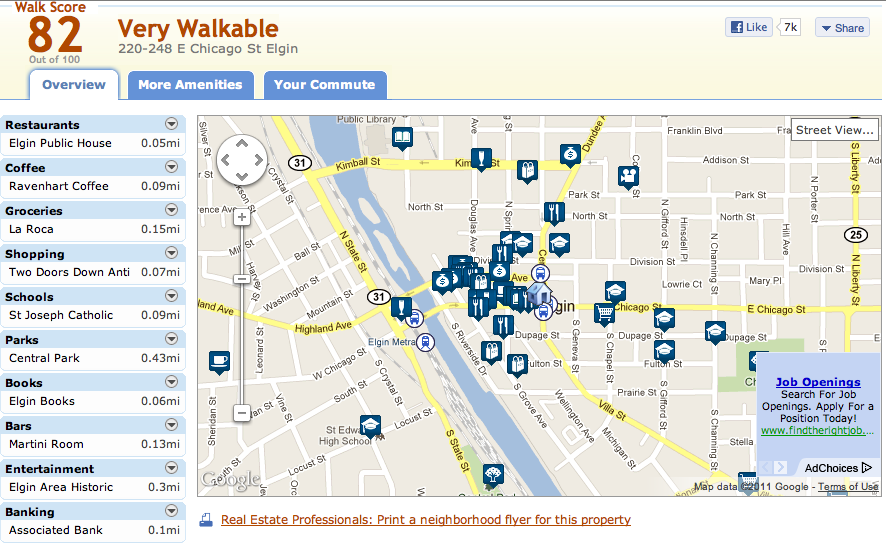
Downtown Elgin’s WalkScore is about 82, or “very walkable.” The site calculates a score based on proximity to transit, schools, parks and several categories of businesses, including banks, restaurants, bars, coffee shops, groceries and entertainment. The database seems to have holes in it – it’s missing Butera, the Speakeasy, and others – but it’s interesting, nonetheless.

Walkability, from the center of downtown.

By contrast, New York is the “most walkable” big American city, with a score of 85. Chicago has a 73. Naperville a 74, Schaumburg 54. In each case, I input just the city name, and it calculated a score for the city center. In Elgin’s case, it appears to use the YWCA on East Chicago Street as the center point. You’ll get a different score if you put in a more specific address. My house has a score of 60.

What do you think? Is your part of Elgin walkable? What would make it more walkable? What keeps you from walking? What would encourage you?

Reverb10 Redux: Elgin Edition?

Last year, I participated in Reverb10, a web-wide blogging activity in which daily prompts urged you to look back at the year nearly done. I enjoyed it, though towards the end I felt like I was repeating myself. I had pretty much decided that I wouldn’t commit to it this year, though I’d keep an eye on the prompts and respond to the ones that intrigued me.

Yesterday, I got an email from Gwen Bell, who created Reverb10 with Kaileen Elise and Cali Harris. They’ve decided not to host Reverb this year, for reasons I understand, but which make me a bit wistful. The trio encouraged people to start their own version of Reverb11 (or whatever) and share the love.

Immediately, my mind split between two options:

1) Read last year’s prompts and re-write them, or at least for the ones that have something worth writing about.

2) Create something Elgin-centric and see if I can persuade fellow Elginites to participate. Daily might be a stretch, but maybe 5 or 6 prompts throughout the month, getting people to name/discuss their favorite aspects of Elgin? Like, “What’s your favorite Elgin holiday tradition?” or “What’s your favorite made-in-Elgin product?”

Any thoughts? If I launch the Elgin-focused option, does anyone have ideas for prompts? I finish the academic quarter next Tuesday, at which point I can exhale and take advantage of some cognitive surplus for a few weeks.

Regardless, I’m starting to mull over last year’s Dec 1 prompt: Encapsulate the year 2010 in one word. Explain why you’re choosing that word. Now, imagine it’s one year from today, what would you like the word to be that captures 2011 for you? Here’s what I said last year.

Welcome to Elgin! A Guide for Newbies (And Lifers)

Two sets of friends recently moved to Elgin. In the course of offering up recommendations and advice, I realized that I could probably crowd-source a much better list. So here’s my first round of advice. What advice would you give to new Elginites? Add your comments below.

The Basics

The City of Elgin website is your first resource for everything from determining your trash pick-up day to establishing water service.

Elgin has several grocery stores. Depending on where you are, you should be relatively close to one of them. Butera, right downtown on National Street at Grove, was recently renovated and has pretty good prices, though they’re only open till 10 PM. We have two Jewels – one on Summit, the other on Larkin – which are, like all Jewels, good grocery stores, albeit overpriced. I like Meijer (Randall/College Green) for my biweekly big stock-up (and late night runs). There are also multiple fresh markets, plus Klein’s Farm Stand on Lillian Street, which gets many of its veggies from a farm just outside of town.

Looking for local news? The Courier-News and Daily Herald are the two main newspapers serving town, though both are experimenting with ways to stay afloat, like charging for access. The Elginite has a good variety of topics and discussion (though be nice and identify yourself in the comments). BocaJump also has local news and opinion. All of these sites have Facebook and Twitter feeds, too.

Books & Coffee 

Gail Borden Library is fantastic. Seriously, it wins awards for awesomeness. Go get a card (free!) and use it at either branch. The main library is downtown, at Kimball and Grove, and faces the river, which makes for a wonderful reading/studying area. They always have a wide variety of events, from book clubs and public meetings to kid-focused activities. The new branch is on the west side, on Bowes west of Randall. The library publishes a biweekly e-newsletter that details all its upcoming events.

Most of the major coffee chains are represented: there is a Starbucks tucked on Randall Road by 90, in the far, far northwest corner of the city, a Caribou a little farther south on Randall, and a handful of Dunkin Donuts locations.

But go beyond those and try the non-chain options. My personal favorite is Domani Cafe on Highland. Try the Cortado (espresso and milk) when you have time to sit and enjoy it. They also have a very limited menu of very good paninis. There’s no wifi, but I consider that kind of a blessing, as I can study without interruption. Closed Sundays.

Also try Ravenheart Coffee on Chicago Street (now open evenings) and the coffee at Elgin Books (also on Chicago Street). Gail Borden Library has a coffee shop on the ground floor. Books at Sunset has some beverages to enhance your browsing. And though I often forget it’s there, I’m always happy when I remember the Country Donuts on 20, just west of Randall.

Food

So many restaurants…

The Elgin Public House and Walnut Speakeasy are two standards for a drink or a good meal. Both are great. I prefer the food at the Public House and the atmosphere at the Walnut, and the latter does have pizza. Both have extensive beer lists and terrific burgers that are half price on Mondays. The Public House also has monthly-ish tasting nights and pairing dinners.  Befriend both on Facebook for the latest specials and events.

In the Neighborhood Deli has a wide variety of sandwiches and paninis, with high-quality ingredients combined in innovative ways. And they’re really involved with the community,  helping out with numerous non-profits, schools and local events.

Toom Toom Thai (downtown) keeps expanding their menu and has a great atmosphere to go with terrific food. White Pearl (west side) isn’t quite as “pretty,” but their Thai food is excellent, with slightly larger portions. (Oddly, their website calls them a “Chinese noodle restaurant,” but I’ve only ordered Thai from them.)

Pizza? We’ve got pizza! Bocajump actually ran a contest last year (results).

As for Mexican, there are plenty of great taquerias throughout town. Everyone has their own preference, but El Faro is my default (two locations – the State Street store is open 24 hours on weekends). And their burritos are giant enough to provide breakfast the next morning, if I scramble an egg. I also really like Delicia Tropical Cafe for Puerto Rican food.

Obviously, there are dozens of other good options. Like Spanky’s Gyros for good, greasy gyros and fries. Help me out, Elginites, with your favorites below!

Things to Do

Every week, there are dozens of activities, depending on your interests. Your best bet is to keep tabs on the Downtown Neighborhood Association and sign up for their weekly newsletter, and expand from there as your interests guide you.

The Elgin Arts Showcase also maintains a trio of calendars for events at the Hemmens, the Art Showcase and other venues around town.

So that’s my beginning of a list. Hopefully we’ll build this list over time to help residents new and old alike.

Welcome to Elgin!

We Aren’t Philadelphia, Either: The Hidden Tax of Poor Schools

Schools - and their perception - are vital to attracting and keeping residents

Before Finals began consuming my every waking, non-work thought, I read the thoroughly fantastic account of the near-death of Philadelphia, Buzz Bissinger’s A Prayer for the City.

Last night, as I scooped up a pile of books to return to the library, I stopped and flipped through Prayer, looking for a passage that has been gnawing at me since I read it earlier this month. On page 372, I found it, transcribed it, and bolded the parts that have been haunting me:

“There was no mystery as to why people were leaving the city. Regardless of what Rendell had accomplished, the city’s pull was still almost purely an emotional one. Those who stayed did so on the basis of loyalty, or because of a job, or because the qualities that had turned so many away from cities were the very qualities that enticed them – difference, diversity, diversion. By any economic basis, the basis on which most people made decisions, the city was still noncompetitive with its surrounding suburbs to the point of impotence. Taxes were still far too high. The perception of crime, far more corrosive than actual crime figures themselves, had not been ameliorated. The school system continued to flop and flounder and had the trust of no one, in large part because of endemic problems, but also because the mayor, cowed by the politics, had never brought to the schools anywhere near the intensity that he had given to the union negotiations, or the budget, or economic development. Those who went to a public school in the city had little faith. Those who did not were forced to pay the burden of the city’s greatest hidden tax – private and parochial schools – until they could no longer afford it, or got tired of affording it, and moved across the boundary.”

[Context: During Philadelphia Mayor Ed Rendell’s first term (1992-1996), Bissinger was allowed unprecedented access to the mayor and his advisors, and chronicled the story of a dying city that had lost $2 billion of its tax base during the prior 20 years and was facing a deficit of $1.246 billion. The city had lost 400,000 people between 1960 and 1990, including a 30% drop in the number of mid-income families, and had a poverty rate of 20%.]

Now, just as Elgin isn’t Detroit, nor are we Philadelphia. America’s truly big cities – and Philadelphia was once the third-largest – have always faced far greater challenges. But some parts of the passage certainly rang true.

Our city is safer than every city of similar size in Illinois, save Naperville, and yet the old perceptions of crime still loom heavily in many people’s minds.

The schools problem rings very true, too. As our local U46 begins its new school year, many continue to send their children to private and parochial schools because they don’t trust the local district. In Philadelphia, during Rendell’s tenure, the Mayor appointed the school board, and thus had oodles more direct accountability. That isn’t the case in Elgin, where our school board is elected, but the “hidden tax” certainly is.

In response to my last post about bringing technology education and training to town, I had Facebook posts that mentioned the vital importance of primary education. People don’t quibble as much when high school taxes go to a district that performs very well. But when their taxes are high and they don’t think the schools are good enough for their children, they either pay the hidden tax of private schools, or move.

More thoughts on this after Finals are over and I can breathe again, but I wanted to start the ball rolling while it was fresh in mind. I don’t have kids, so my experience with the schools is purely perception, but that’s part of the problem. Even if the schools are fine, they are perceived as quite the opposite.

We must work together to fix our schools (and, just as importantly, their perception) before we lose more good residents and before more decide against moving to Elgin in the first place. In an era of terrible funding challenges, this is a gigantically tall order, but not impossible. Suggestions on how we start?

I highly, highly recommend the book. Bissinger weaves together several stories of average citizens and their struggles, from a welder in the doomed shipyard, a city employee, a prosecutor and a woman raising her great-grandchildren, while incorporating the years he spend with Rendell and his chief of staff. Plus, he’s a fantastic writer and storyteller.

Bringing Education to Elgin

Education is vital to our economic growth

My recent What Elgin Can Learn from…Detroit? post generated quite a bit of buzz and conversation, both here and on other social platforms. I’ve been thinking about it a lot lately, and you’ll be hearing more soon. (In the mean time, your feedback is still appreciated!)

In that post,  I talked about how non-negotiably vital it is that we diversify our Elgin economy while also prioritizing education at all levels.

Yesterday, I saw a post from Laurie Faith Gibson-Aiello of the Gibson Group that discussed how important an educated workforce is – and how the Elgin Technology Center is trying to bring these skills to town. ETC has applied for a Motorola Mobility Foundation grant that would enable them to build a tech training facility right in the heart of downtown Elgin, educating the 150+ members of ETC while also serving to mentor new entrepreneurs.

This is exactly the kind of energy we need in Elgin. Through coordinated efforts, we can bring in new businesses that can leverage some of our great attributes, like our location and easy connections to other cities. Good luck to the ETC in their efforts!

And maybe in the fall, we can apply for an IBM Smarter Cities grant, too.

Art & Soul on the Fox

Saturday, I took a (very long) detour on the way home from studying/coffee and walked through downtown Elgin’s Art & Soul on the Fox festival. It was fantastic! I had passed through the festival last year while out for a run, but hadn’t really stopped.

Booths lined Grove and Spring Streets, and DuPage Court held a stage and a variety of food and drink options. I bought a few pairs of earrings and almost bought a ring, before I remembered the pretty inlaid mother-of-pearl ring I bought in Istanbul on a similarly humid day that I’ve never been able to actually wear.

Besides the plethora of fun jewelry, there was a wide variety of art, from oils and photos to mirrors and pens and kitchenware.  As I travel, I try to buy souvenirs that I can see or use daily. I have watercolors from San Francisco, clay puppets from Greece, painted frogs from Cancun, a little diorama from Krakow, a tile adorned with whirling dervishes from Istanbul… but I have nothing from the place I actually live. One of the artists helped me fix that, as Elginite Steve Sturgill had some great prints of local landmarks on display. I was struck by a print of the Tower Building, with bright hues that will look great in my living room. He also had some nice prints of Metra trains that are far better than any of my feeble attempts, so I picked up one, as well. He said the Elgin prints had been selling very well all day. How many other towns   can do such brisk business selling photos of their landmarks? (Heck, how many towns have recognizable landmarks?)

While wandering, I ran into several friends and neighbors that I stopped to chat with, and I waved hello to several others. Live music wafted through the streets. Finally, I grabbed fresh squeezed lemonade for the walk home through brilliant sunshine.

It was hot and sticky, and I got home two hours later than planned, but it was a great summer Saturday. I’ll definitely go back next year.

What Elgin Can Learn from… Detroit?

This quarter, my Economics class is reading and discussing Spend Shift, a fascinating look at how the economic recession is pushing Americans back to more traditional values and, as a result, shifting how and what we buy.

Each chapter features a case study of how a city is experiencing a shift in these values. One of the chapters, “The New American Frontier: Detroit,” had me nodding vigorously and thinking, “Yes! Absolutely!” while also wondering, “Detroit? Really? Detroit-Detroit?”

In a sweet little twist of irony, I was reading that particular chapter while sipping coffee at downtown Elgin’s Domani Cafe, where I often go for Saturday studying. (Try the Cuban sandwich. Trust me.) Downtown Elgin has suffered some of the same challenges as Detroit, though on a much smaller scale. The manufacturing base that was so strong a century ago has fled – the watch factory and its supporting industries employed thousands, as did the dairy industry. Crime was a very real problem in the downtown through the 80s and 90s. Property values dropped (and are doing so again, though not quite to Detroit’s level, where the median home price is $8,000 and the Silverdome recently sold for a mere $583,000.)

When I first moved here in 2006, many still knew Elgin by its old reputation and asked if I was crazy. But I saw a great town with more character than most of the commuter suburbs, and an opportunity to really make a home.

A handful of brave entrepreneurs have also seen opportunity over the past several years and moved into the downtown core, taking advantage of low rents. More recently, the Downtown Neighborhood Association and the city have been working to help promote this migration. Not all the fledgling businesses have made it – several years of streetscaping construction have made it difficult for potential customers to navigate and park – but things are looking up.

In Detroit, entrepreneurs aren’t afraid to try new things, because the cost of failure is relatively low. With very low overhead and building owners desperate for tenants, businesses can afford to experiment a bit and be creative in their efforts. Spend Shift talks at length with the owners of a French bistro, an art gallery, and a creperie – all of whom took risks that have paid off. The business owners are united for a stronger city, and in early 2010, they drafted what they called “The Detroit Declaration,” a set of twelve principles that is to guide their future. This movement continues to gain momentum, and a related Facebook page has nearly 14,000 fans who actively discuss many of the city’s issues.

Several of the delcaration’s tenants could be taken to heart by Elginites who want to improve our fair city. Here are a few that seemed most relevant to me, with my take on how they apply. (View the full thing.)

Preserve our authenticity – “Celebrate and elevate” Elgin’s unique qualities, like our river, our location, our parks. How many cities our size have a zoo, an opera, a world-class symphony and an award-winning library? Sometimes, when certain proposals come up, naysayers moan, “We’re not Naperville/Geneva/Chicago.” And we’re not. It’s time to stop trying to be something we’re not and celebrate who we are.

Diversify our economy – For decades, Elgin relied on a couple big industries – namely watch-making and dairy. When they went bust, so, too, did our city’s employment rate. While the city is making strides at this with new industries (Siemens, Wanxiang, etc), they should do more to promote the smaller businesses that actually create jobs, rather than existing companies that merely import jobs. Groups like the non-profit, grass-roots Elgin Technology Center have a lot of potential to incubate these small businesses and build connections among them to help them succeed. Giving incentives to multi-national companies who have already signed leases to move here only make us more dependent on large companies, which is never ideal. If the city must spend money on incentives, invest in smaller, innovative businesses who have room and ideas to grow. A little bit of money can go a long way with start-ups, rather than hundreds of thousands of dollars to multi-nationals.

Enhance quality of place and Demand transportation alternatives – Detroiters define this as “a comprehensive vision for transit-linked, high-quality, walkable urban centers,” which is good, and valid for Elgin’s downtown core. But connecting the other parts of Elgin to the downtown core – via bike paths and other links – are just as important, as big portions of the population live within 5-10 miles of downtown proper. Currently, they spend their dollars along Randall Road, often out of city limits. I occasionally run into lifelong Elginites who haven’t been downtown in years and have no idea what has developed there.

Prioritize education, pre-K through 12 and beyond – We must do something about U46, as it is the biggest detractor for many potential residents. People with children want to live in areas with good schools, where their tax dollars fund a solid public education. They don’t want to have to pay private school tuition on top of their taxes – of which U46 comprises the largest share. Whether or not the current reputation is deserved is another issue. But regardless, we must demonstrate that education is vital to this town – and then prove it. We have two higher education institutions – ECC and Judson University – an advantage few other towns can boast. Let’s leverage them.

Demand government accountability – Especially during  a recession when many have lost jobs, are underemployed, have seen pay cuts, etc, we become more concerned with how our tax dollars are being spent. We’ve all tightened our belts – shouldn’t government do the same? Elgin is making some cautious steps towards this. I’m holding my breath until the Budget Task Force is announced – who will they pick from the 57 applicants? – and to see how wide they open the books. We can hope their recommendations are truly in the taxpayer interest and that the Council enacts reforms. Meanwhile, groups like Elgin OCTAVE show promise for being good, necessary watchdogs that can ask tough, necessary questions of our spending habits.

Think regionally and leverage our geography – We’re just 35 minutes from O’Hare – and the opposite direction of the worst of the traffic. Chicago is less than 40 miles away, and we have a relatively reliable train link to Union Station. We’re halfway between Chicago and Rockford, with a huge pool of available workers. If we play our cards right, we can draw from a huge metropolitan population. I’ve heard the city make similar claims, but I don’t think we can do too much of this.

What do you think? Do we need an Elgin Manifesto of sorts to rally around? Or are we already on this path? Does this resonate with you – or am I completely off base?

At Last, Summer

It finally feels like summer. Sure, I may need a hoodie, and it’s too cold to leave the windows wide open, but tonight I reprised one of my favorite summer activities: the Tuesday night concerts at Wing Park.

Every Tuesday night, a different band plays at the Wing Park Bandshell. A group of neighborhood folks stakes a claim on the lawn, bringing snacks and treats and bottles filled with “magic water” or “kool-aid.” I bike over – it’s about three miles each way – with a blanket and snacks in my backpack.

We listen to music, but it’s not about the music. Tonight, one of my favorite local bands, Seventh Heaven, played a very laid-back set, perfect for the crowd. Kids play, running around, blowing bubbles, and dancing to the music. Some people bring fast food –  I smelled pizza and fried chicken tonight – and others pack picnics. My group usually brings some combination of cheese, crackers, fruit and something sweet.

We chat and visit and just enjoy being outdoors. Sometimes it’s very hot for the first few songs until the sun dips behind the trees, but that wasn’t an issue tonight, as I pulled out my hoodie and zipped it against the chill.

And then, when it’s over and the band says good night, everyone packs up and hugs and vows to return next week. As the cars line up to get out of the lot, I glide past them on my bike, zig-zagging through quiet neighborhood streets as the streetlights come on and the fireflies lazily flicker my path home. The chill feels good.  Night riding is such a treat, unimaginable 8 months of the year. I feel free and swift and content with the world.

Tonight, as the moon rose higher in the sky and I coasted home, REM popped to mind.

I went to an Iron and Wine concert last week in Chicago’s Millennium Park , and it was a completely different experience. Overly crowded, with battles over turf, and the crowd was louder than the music. It made me appreciate my Wing Park crowd even more.

We’ve fought through a cold, wet spring, but I’m so glad it’s summer.

What’s your favorite summer tradition?

The Sweaty Fox Trot

I’ve finally been running long enough that I’m repeating races!

My very first race last year was the Elgin Fox Trot, and I treasure the experience. This year, it was nearly an afterthought. I had registered plenty early, but then got busy with school and the crazy two half marathons. Suddenly, it was the end of May, even if it didn’t feel like it.

It was such a cool spring, too, that I didn’t have a single run under my belt where it was over 70 degrees. But the night before the Fox Trot, after a day of heavy storms, the temperature began to rise, trapping the humidity.

By the time I left for the race, at 7 AM, it was nearly 80 degrees with 93% humidity. I slathered on the sunscreen, grabbed my sunglasses (as my friend Brady learned, you can burn your eyes!) and set off.

I love having a race so close to home that I can walk to the start line, though it does complicate things a bit. I had to wear my annoying belt that bounces as I run, even though it had only my phone, ID, housekey and a few dollars inside.

The race was hot and sticky, and I quickly realized how unprepared I am for hot weather running. Of course, I started too quickly – damn adrenaline – and ran the first half mile at about an 8:00 pace, effectively cooking my lungs as we ran up the Chicago Street hill. By the time we turned onto the shady residential section of the course, I was thankful for the water station at mile 1. And again for the Near West Neighbors-sponsored station at mile 2.

I ran the entire thing, save for grabbing water, but it was not an easy run. My legs felt strong, but my lungs fought me as my allergies flared up. The last mile along Douglas Avenue – a slow, gradual downhill grade mostly shaded by grand, old trees – should have been easy, but the strong breeze was blowing southerly hot air straight at us.

So I finished just slightly worse than last year’s time. But I’m pleased, given the day and my preparation. I had a blast. Hanging out with friends afterwards,  it was downright pleasant sipping beer in the shade.

Too soon, I had to head home, grabbing an iced latte from Domani on the way, ready to face the Statistics exam that had been at the back of my mind all day. After a shower and lunch, I settled in for a long, frustrating afternoon, staring wistfully outside at the sunshine. When I finally finished (or rather, realized that staring at it longer wouldn’t help), I did get back outside, but only to mow the lawn.

It’s amazing how productive you feel on a day that starts with a race.