Monthly Archives: February 2012

New Neighbors, via Habitat

Sunday, I went to the House Blessing for the latest Habitat for Humanity project. I volunteered on the site a few times early last year, and then got sucked into school. But for the past 18 months, I’ve often passed the house while running or biking, watching the transformation.

Pilar and her children, as Tammy (left) and Marlene look on.

This house, on Moseley Street in the SWAN neighborhood, was the first WomenBuild for Habitat of the Northern Fox Valley. From demolition to final detailing, every step was handled by women. Marlene Hensrud served as project director, and Tammy Guilinger as forewoman. Both taught me a lot about construction, rehab and community.

Sunday was especially special. At the blessing, the old house was filled to the gills with volunteers, family, friends, new neighbors, and well-wishers. A pastor led prayers for the home and the family, and Marlene and Tammy handed the keys to Pilar, the new owner. Pilar and her two children will move in next month and finish the final painting and landscaping in the spring.

The house had been vacant for years, an eyesore on an otherwise nice block. As with any vacant house, there’s always concern about its fate – and how it will impact the rest of the block. Will the house find a new family? Will it be bought by an unscrupulous landlord, bent on carving out as many apartments as possible? Or will it just remain vacant, owned  by nobody, crumbling bit by bit with every storm or stiff wind?

The house was built in 1863, making it one of the oldest houses in the neighborhood. The future did not look good. But with funding from the federal Neighborhood Stabilization Program, the City purchased the house as a strategic rehab, turning it over to Habitat to conduct the work. The project finished below budget. (I’m not generally a fan of programs like NSP, but Habitat has handled its houses in a much more fiscally responsible manner.)

I know the neighbors are looking forward to welcoming the new family. And as construction sounds echo down my own street, I hope my nearby eyesores will find similar TLC in the months to come. The housing crisis has hurt so many, but maybe we’re finally starting to see some success stories.

On one side of me, an 1860s house left for dead and condemned has been fixed up and now is one of the nicest on the block. On the other side, the long-empty home now looks far worse than ever – but that’s because the new owner is busy replacing windows, the roof, the siding and all the innards. A few blocks away, a neighbor reported that the house next door to him – vacant for sixteen long, long years – was just bought by a new couple.

Are you seeing similar signs of hope in your neighborhood? I know things are still very bad – and so many good people lost their homes – but I wonder if prices have fallen far enough that people are willing to take a chance on some of these old homes with good bones.

A Tale of Two Neighbors

This morning, I woke to several inches of fresh, beautiful, slushy snow.

The radio said it was “heart attack snow,” as the water content was very high. I told myself it would make a great workout – but finding the (preferably day-lit) time would be tricky.

But barely an hour later, as I was on my first conference call of the day, I heard a growling from the street. A minute later, my neighbor appeared on his ATV, with a plow blade strapped to the front. He quickly turned my slushy heart-attack mess into a neatly cleared driveway. He even did the sidewalks for half the block. Hooray for good neighbors! I will bake a sweet thanks this weekend.

Across the street, I have a different type of neighbor with the local car stereo/rims/alarms business. For months, I’ve noticed a correlation between the presence of the bright red Hummer and the house-shaking bass that rattles the pictures on my wall.

Earlier this week, for the first time, I saw the front of the Hummer. (Usually, it’s parked facing the building.)

It seems rather appropriate, don’t you think?

It takes all kinds.

A Woman’s Place

Late last night, I flipped the final virtual pages of Sinclair Lewis’ The Job: An American Novel (free for Kindle!).

I love books that fit the genre: set in the early 20th century, starring young women who find strength in fending for themselves and making it in the big, bad city. (See also: Theodore Dreiser.)

The Job spanned a decade starting in 1905, when Una Golden and her mother moved to New York City from a small Pennsylvania town. Una’s father had just passed away, and after the dust settled, the mother and daughter decided that a big city like New York held more opportunity for a young woman to earn a living (and support her mother).

Such “opportunities” were vastly different than what women expect today. After a quick stint at secretarial school, Una started her career by taking dictation, eventually running small offices. Throughout, her fellow secretaries and stenographers married and left their jobs. The message – and reality – were clear: women had to choose between work or family. Women tended to work only when they had to support themselves in the absence of a father or husband. Una struggled to reconcile her desire for a family with her career aspirations.

As I read, many of the office dynamics were familiar, with hierarchies and break time confidences. But I marveled at just how far we’ve come in a century.

My own company, IBM, recently named a new CEO. As of January 1, Ginni Rometty was named President and CEO – IBM’s ninth CEO in a century.

Ginni Rometty is IBM's new CEO and president

When the news was announced in October, the gender-focused headlines bothered me. Why should it matter that she’s a woman? That our best and brightest, someone who worked her way up through IBM’s ranks since 1981, happens to be a woman? We should applaud the best person getting the job, regardless of gender.

But I know that it is a big deal. As long as Fortune and Forbes keep putting out lists of “Most Influential Women” and we have stand-alone “Women in Technology” receptions at conferences, the divide will persist. (Can you imagine if they had a “Men in Technology” night at a software conference?)

I grew up truly believing I could be anything I wanted to be. It never occurred to me that being a girl limited my career choices. I could be a doctor, a lawyer, a teacher, or even an astronaut, as long as I worked hard. (Funny, “social media strategist” never popped to mind as a career option back in the 80s or 90s.)

But not terribly long ago, that wasn’t really the case. When my mom applied for teaching jobs in the 1970s, she had to include a headshot and answer questions about her marital status and whether she intended to have children.

It’s certainly changed in the century since Una Golden arrived in New York. Even so, I look forward to the day when gender isn’t highlighted as something novel during such announcements.

We’re getting there. Our outgoing CEO, Sam Palmisano, reiterated the point: “Ginni got it because she deserved it. It’s got zero to do with progressive social policies.”

Congratulations, Ginni, and thanks for helping perpetuate the reality that a woman’s place can be in the board room.

The New York Times has an interesting look at women in technology, and specifically, women in IBM. 

Pawnshops and Perceptions

Last night, I spoke against a new pawnshop that has applied to open in the Town & Country shopping center (McLean/Lillian, in the old Trefon’s).

I’ve learned a lot about the pawn industry lately. It’s not nearly as seedy as I thought. Pawnshops are actually a much better option for people than the payday loans and cash-for-gold shops that have sprung up like noxious weeds. They’re tightly regulated by both the state and city, and work closely with the police to report their daily intakes. They make their money through loans, and in the end, the customer often gets their item back, to re-pawn later if needed. With cash-for-gold stores, items are quickly melted down, never to be seen again.

But sometimes, reality doesn’t matter nearly as much as perception.

Perceptions run deep. They start in childhood and grow as you’re exposed to the world: to your parents, to television and movies, to friends, to teachers. And those perceptions, once baked in, are very tough to change. When cobbled together, perceptions form images of people, communities, or things.

Elgin knows this. Elgin fights perceptions daily, constantly crafting and re-casting Elgin’s image. In the six years I’ve lived here, my marketer’s heart has marveled at all the effort that goes into crafting and re-casting Elgin’s image.

  • We spent $75,000 (!) to redesign our city logo and develop a slogan: “The City in the Suburbs.”
  • We have an Image Commission that gives annual “Image Awards” to recognize “image-enhancing efforts from Elgin residents, businesses and civic organizations.”
  • We build and rebuild websites to lure companies from abroad, filled with pictures of diverse, happy people who have somehow found an Elgin where it’s always sunny.

Image is on the minds and lips of city officials, not to mention residents who contradict outdated perceptions that continue to tarnish our image decades later.

We spent oodles of money on fancy brick pavers and new streetscaping for downtown. We celebrate ECC as a major regional destination. The city tries to lure golfers to the courses it owns, including one right by the proposed pawnshop. Thousands of out-of-towners come to Larkin High School every year for various sports and other extracurricular activities.

Each person who comes into our town makes or affirms their own perceptions of Elgin. Each presents an opportunity to change their minds, to shake their perceptions of the Elgin of old. For the younger people headed to ECC or Larkin, it’s often a first impression. So we talk about how the entry corridors fuel these perceptions.

And yet, when faced with a pawnshop to open at a major interchange and entry point, we allow it.

Don’t get me wrong. I’m all for letting the market decide what types of businesses can open in a given area. But the city puts pawnshops in a separate category for a reason. Until a year ago, there were none in town. The city created a special type of license for pawnshops, and issued only one, to Windy City Jewelry & Loan. Windy City doesn’t use the word “Pawn” in their signage. They don’t overtly advertise that’s what they do. (Interestingly, the city has no such restrictions on payday loans, cash-for-gold shops or similar businesses. By my count, there are at least 20 such businesses scattered around town, including one already in the Town & Country shopping center.)

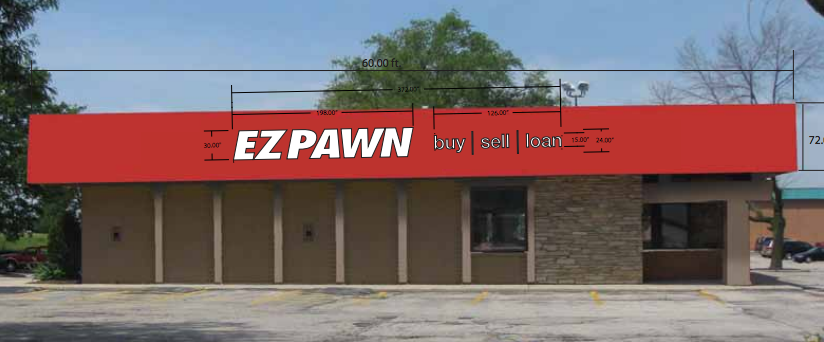
Rendering of EZPawn's proposed signage

But this new shop will have “EZPAWN” emblazoned 30 inches high by 198 inches wide, on a bright red background. Depending on how they position the sign, it will be one of the first things people see when they exist Route 20 at McLean, or even as they drive past on 20. That includes people going to Larkin, ECC and the Highlands golf course.

The Zoning Board recognized this and asked the petitioners if they could perhaps not use the word “Pawn” on their sides, and instead use the corporate name, EZ-Corp. But EZPawn is the trade name, so of course they’ll use their name on their signage.

The Board ultimately approved the proposal, which now heads to the City Council for final approval.

Whatever you personally believe about pawnshops, the widely held perception is not good. Thanks to my research, my perceptions have certainly changed. (Plus, Google now serves me lots of ads for pawnshops, payday loans, and bankruptcy attorneys.) But if someone already has less-than-ideal image of Elgin, how will that sign change – or affirm – their perceptions?

Am I off base? What do you think?

View the entire petition and Zoning Board details. Full disclosure: in my capacity as president of the South West Area Neighbors, I did write a letter based on input from the neighborhood, and spoke at the hearing. 

Do Gamblers Like Opera?

Elgin’s Grand Victoria Casino sits just south of downtown, several thousand tons of ostensibly “floating” entertainment.

Elgin’s Hemmens Cultural Center, home to the fantastic Elgin Symphony Orchestra, is less than a mile away, in the heart of downtown.

Both attract steady audiences to Elgin, though the casino’s numbers are down significantly in the past couple of years.

In theory, both venues should drive crowds to the growing restaurant and bar population that’s trying to take hold in downtown. But in reality, that doesn’t really happen, particularly with casino patrons who have their pick of dining options within the casino’s confines.

Last week, the City Council decided to pursue a study that will evaluate the feasibility of an entertainment venue that could serve both purposes: hosting the ESO and growing arts community while also serving the Grand Victoria’s need to compete with the new Rivers Casino in Des Plaines. (Thankfully, we’re not paying for this $45,000 with tax dollars. The Grand Victoria’s parent company, HGMI Gaming, will foot the bill.) While a location hasn’t really been determined, some have floated Festival Park, given its location between the casino and downtown, as a logical space.

Mike Danahey’s wonderfully comprehensive Courier News piece covers the biggest issues: Festival Park is the only green space in downtown; the need to be good neighbors to the townhome residents who have struggled with noisy downtown venues (namely the Main Event), and the odd pairing of gambling and arts. This is the part that really piqued my interest.

Elgin talks a lot about becoming a destination for the arts. The ESO has been an institution since 1950, and we have plenty of smaller groups like Elgin Opera, Janus Theatre, Elgin Theatre Company, Elgin Art Showcase, and others I’m surely forgetting. ArtSpace is becoming a (taxpayer-funded) reality that will bring 55 artists to downtown. SpaceTaste Gallery has periodic shows and really unique things to see.

In that sense, the Hemmens has outlived its useful purpose. Built in 1969, it has only 1200 seats, strangely configured. The acoustics aren’t worthy of the ESO – I was blown away when I went to a recent ESO concert at the Prairie Center in Schaumburg. A new facility is overdue, and would offer more flexibility to serve the growing variety of arts needs.

But I still struggle with how one venue can successfully meet the needs of such disparate groups. As Danahey points out, facilities hosting symphony concerts are inherently structurally different than those hosting casino shows that feature rock and pop acts. A single facility might serve the traditional arts (symphony, opera, stage productions), but would not have the bones needed for a more contemporary act, and vice versa.

Facilities aside, lets consider their respective audiences. Do gamblers like opera? Do we care if they do? I don’t see a lot of mingling of audiences. Would most casino goers consider attending an ESO performance?

I think we need to be realistic that such a venue would have to serve two distinct audiences. While that’s not impossible, it takes very careful planning. Understand who your audiences are. Research their respective needs. Admit that there won’t be much overlap. Work with local complementary businesses to cross-promote where it makes sense. While casino patrons may not attend gallery openings, ESO-goers may be interested. I haven’t see that kind of connection to date, and it’s a relatively easy win.

I do think that a facility bridging the tundra between the casino and downtown may help downtown businesses. I love the openness of Festival Park (see my header picture at the top of this blog), but standing at the casino, looking towards downtown, the empty expanse seems endless. And if you do venture north into downtown, the first block of Grove is a ghost town, with far too many vacant storefronts. The new Prairie Rock Grill will anchor this corner, and hopefully bring in traffic that will help encourage other businesses.

What’s your take?