Category Archives: Elgin

5 Years at Home

It’s my fifth housiversary!

The first summer

I closed on this house five years ago today. On previous housiversaries, I’ve blogged about that first day, and about random spring cleaning.

But this morning, I was feeling reflective. We tend to do that on birthdays and anniversaries that are divisible by 5.

When the alarm went off, I laid in bed for a few minutes, stretching and yawning, listening to talk radio as my brain woke up. I gazed over the river and watched the sunrise sparkle and shimmer on the water, promising another bright spring day.

Sure, I’ve done a lot of improvements, replaced a lot of windows and doors, painted, maintained, etc. And there are still things left undone from the very first to-do lists.

But more than anything, I’ve made this a home in a way that none of my apartments ever were. Living in a place over an extended period of time, you get comfortable. You try things in different places and learn that the Christmas tree fits best along that wall, or the best place to put the patio table for optimum sunshine. Every spring, the bulbs planted that first fall continue to delight.

You spread out, and hang souvenirs and photos throughout the house. Add shelves, configure storage, and reconfigure six months later when you find a better solution. You add scuffs to the walls and baseboards from day-to-day living and moving around.

The place is thick with memories. From turning the key that first day to celebrating new jobs, birthdays and grad school to surviving snowfalls and basement geysers, every room brings back a flood of memories and moments, from the monumental to the mundane.

Most of all, though, it’s home. There’s a sense of relief that envelops me as I cross the threshold after a rough day. It’s knowing that I don’t have to abide by an Alzheimer’s-addled landlord who forgot he cashed my check and threatened eviction.

And it’s community. I moved to Elgin knowing barely anyone, and not really sure I knew what I was getting into. But the neighbors and community I have found have surpassed my wildest expectations and make the entire neighborhood and city, beyond my property lines, truly home.

So here’s to the first five years. They weren’t perfect, and I really, really need to finally replace those damn light fixtures that have bugged me since Day 1, but I’m lucky to have made such a great home. Here’s to many more.

Signs of Spring

Friday’s post sparked a Facebook discussion about the role of signs in elections.

They’re often the first sign of a coming election, sprouting up like dandelions from still-frozen ground. Usually patriotic blue or red, with festive stars, but the last few years, you’ll see attention-grabbing green, purple and yellow.

But how effective are they? Do signs influence elections? They must, or candidates wouldn’t allocate precious campaign dollars towards them.

The irony of the library board situation I mentioned Friday is that this slate of candidates has plastered their green and white signs all over town, including in tree banks and on public right-of-ways where they’re technically verboten. Yet, the same trio hasn’t bothered to attend candidate forums or answer questionnaires about their positions.

Note the three green and white signs within about 100 feet. And there were additional signs around the corner of this busy west-side intersection

While out for a long, slow, cold 7 miler Sunday, I was mulling over the sign conundrum. I started counting the green and white slate signs, losing count when I hit 20. They were often clustered together with other candidates, and seemed to be sprinkled heavily at major intersections.

Also interesting to observe were how the different signs were paired. Officially, our municipal elections are non-partisan. We get to pick three council members out of ten candidates, and one mayor from two candidates. Several alliances have sprung up, some formal, most informal, and this is sometimes reflected by how the signs are grouped.

But not always.

And how do the signs end up so strategically placed? The times I’ve hosted a sign in my yard (including my current Curtin for Council sign), I’ve always asked for it. But I’ve heard numerous anecdotes of signs magically appearing overnight, or disappearing, as the case may be. This seems particularly prevalent on highly visible blocks.

Do residents know who these candidates are when signs appear on their yard? Do they just not bother to remove them? Are they inspired to go look up information on the candidate in question? Do they know that the candidates on their sign refuse to answer questions?

While running Sunday, I paused a couple times to take pictures. I couldn’t get a good, non-glared shot of the biggest sign farm I saw along McLean, where at least a dozen signs clustered in a vacant lot, competing for attention.

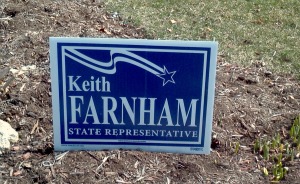
I wonder how long these signs will stick around after the election. Both Keith Farnham and Michael Noland were elected in November, and yet their signs remain all over town.

Do signs influence your political choices? Would you ever vote for someone just because you see their signs all over the place and think, “Hey, they must be popular/good/wealthy if they have so many signs”? Or do you use signs to become aware of which candidates are running, and do your research from there?

Showing Up: A Sign of Respect

Elgin will hold municipal elections on April 5. Like the political nerd I am, I’ve spent part of my spring break going to candidate forums. You can read all the profiles you want, but there’s something about hearing candidates answer questions live, without hours to carefully choose written words, that shows their true character and intentions.

Last night’s forum was held at the Gail Borden Library, which is a phenomenal asset to our town. The forum was for mayoral and library board candidates.

Typically, it’s these smallest elections – for library boards, school boards, park districts, etc – that get overlooked. Even politically engaged citizens who do their homework on the marquee races (mayor and city council, in this case) often shrug and close their eyes when they get to that part of the ballot.

But they’re just as important as the higher profile positions. In this case, the library board manages taxpayer dollars and sets the direction of the library. Given how much I get out of the library, it’s a part of my tax bill I’m happy to pay – but I want to know that those dollars are being spent wisely. And one of the current board members – elected the last time around with the usual amount of voter indifference – has proved to be an obstacle to progress, demonstrating just how important it is to choose our board wisely.

Given this history, I really wanted to hear from the library candidates. Essentially, two “slates” have formed among the nine candidates running for five seats. I was curious to hear the differences between the slates, as politicians often try to cater towards voters by not taking any position that could be remotely controversial. (I believe all candidates last night agreed that they do indeed like books.)

But three of the candidates didn’t bother to show up last night.

One of the “slates,” consisting of Victor LaPorte, Richard Wallett and Penny Wegman, skipped the forum entirely. (They’re the trio on the green signs around town.)

While this made for a rather amicable forum, it wasn’t fair to voters, though it certainly made my decision easier.

By not bothering to show up at the only forum for library candidates, co-hosted by the library itself, Wegman, LaPorte and Wallett showed they don’t respect voters, the process or the library.

If elected, would they bother showing up at meetings? Would they bother listening to constituents?

Let’s not find out. But do show up at the polls.

Note: After this post inspired the comments below and a Facebook discussion, I wrote a follow-up post on the role of signs in an election.

Hammering with Habitat

On paper, Habitat for Humanity is a good fit for me: I’ve always fancied myself a bit of a DIYer, and pride myself on (at least) trying to take care of a lot of the maintenance demanded by my old house.

But I never realized how much I don’t know. And how much bigger the stakes are when it’s someone else’s home, not yours.

I first volunteered over the summer, during Habitat of the Northern Fox Valley’s Blitz Build project, where they gutted and rehabbed an entire house in just 20 days to celebrate their 20th anniversary. (Since the housing market currently has an abundance of vacant homes, Habitat is buying and rehabbing existing homes rather than building new – which I thoroughly support.)

Then serendipity intervened. As part of the federal government’s Neighborhood Stabilization Program, the city of Elgin received money to buy and rehab a dozen or so houses to reduce the glut of vacant homes. And they partnered with Habitat for some of the homes, one which was slated to be HHNFV’s very first WomenBuild Project.

It’s in my neighborhood.

I spent a couple wonderful autumn Saturdays doing demolition work, breaking up a cistern, pulling down drywall and cabinets and other projects. Demolition really is good for the soul.

But then school got in the way. It’s really hard to give up an entire Saturday – and wake up early – when facing hours of homework. So I hadn’t been out to the build site for a while until a January Saturday.

I assumed we would be working inside, as the temperature was in the low 20s, with a windchill barely a single digit. I knew the house isn’t yet insulated or really heated, for that matter, so I dressed warmly. When I arrived however, I discovered we would be outside all day, working on the new garage. Half the team was on the roof, shingling, while I and others framed the inside of the garage. I thought about running home to put on additional layers, but I was engrossed and didn’t want to walk away, so I stuck handwarmers in my gloves and boots and took periodic breaks inside. (I also worked “inside” the garage quite a bit.)

Habitat days are wonderful learning experiences, though they can be frustrating. I always realize how much I really don’t know as Tammy, our fantastic forewoman, gives instructions. Since I’m working on someone else’s house – a wonderful woman with two kids, a family – I don’t want to mess up. On my own house, sure, I want things done right, but the consequences only affect me.

The first day I volunteered, during the Blitz Build, was great because the house was being put back together. In the course of a day, I helped hang cabinets – after reading the diagrams and measuring multiple times –  and prepped the bathroom for tile.

Working on the WomenBuild house has been different, though. There have been moments of frustration, when I thought I knew how to do something that I really didn’t, like when I realized I can’t hammer a nail in straight to save my life. Moments when I heard my dad’s voice, saying, “We’ll make a carpenter out of you yet,” as I cut 2x4s. Moments where I sucked it up and climbed a ladder. Moments of exhilaration as I discovered the magic of the palm nailer.

It’s humbling to realize how little I actually know, and how much there is to learn. And yet, this homeowner-to-be has entrusted this organization with rehabbing a house for her and her family. The neighborhood has entrusted Habitat with revitalizing a house, originally built in the 1860s, that has sat vacant for years, and bringing life back to that corner. The city has entrusted Habitat with the money to do so, and indirectly, the feds have sent taxpayers’ hard-earned dollars to this corner.

I know I’ll go back again, because no matter how much I’m frustrated, I know the lessons will translate into my own home.

And sometimes, it’s good to step away from the schoolwork.

Snowpocalypse 2011

As you might have heard, we got a bit of snow last week. Snowpocalypse, or #snOMG as Twitter was calling it, was unlike anything I’ve ever seen or experienced. I vaguely remember the 1999 storm, but I was a senior in high school still on Christmas break.

This storm was incredible for its fury. All week, Skilling and others kept raising the expected accumulation totals and narrowing down the exact hour the storm hit. And they were right.

I woke up Tuesday morning to a fresh inch or so of snow and word that Metra was rearranging their afternoon schedules to help people get home ahead of the storm. All day, the skies were relatively clear. Until 2 PM, when suddenly, I looked out the 22nd floor windows and saw snow blowing horizontally, swirling violently.

The few coworkers who had come into the office started leaving to catch the special early Metra trains. I heard that Union Station was chaotic, so I decided to wait an hour to let things thin out a bit.

I left work at 4:15 and hunched against the wind and snow until I got to the eerily empty Union Station. I boarded the 4:50 train, which closed the doors right on time, with several empty seats. We sat for 10 minutes and then departed. Just past Western Avenue, we stopped. And sat. For nearly two hours. The conductors had no information, but I was able to learn from Twitter that there was a switch failure ahead. We sat on a bridge, near Damen and Grand, as the wind rocked the train back and forth. I was hungry and cursed myself for leaving an apple on my desk. Another passenger joked about ordering a pizza, if we could convince someone to come to the rail bridge.

Eventually, we pulled into Elgin just before 8 PM, and I made a very difficult walk home, as the 40 mph winds flung snow at and around me, obscuring my vision and sucking my breath. Scenes from Laura Ingalls Wilder’s Long Winter filled my head, as I thought of pioneers getting lost in blizzards, stringing clothesline to navigate from house to stable. I wish I had a rope to follow home.

As I killed time on the train, I had seen several Twitter friends mention power outages. When I finally got close to my house and saw the porchlights, I breathed a sigh of relief. But as I trudged through the drifts on the driveway, I found a couple shingles. I think they’re from my roof, but I’m still not quite sure. I had made it home, but had to dig out my back door, which was already encased in snow nearly up to the doorknob.

As I left work, I had hoped to settle in early and study, but after a four hour commute, I curled up with a glass of wine and listened to the storm. I’ve been in this house nearly five years, and I’ve never heard it rock and shake and creak quite like it did Tuesday night. I followed the storm on Twitter, as Elgin’s city manager tweeted from a snowplow, and crossed my fingers every time the power flickered. Finally I went to bed, but laid awake, listening to the howling storm.

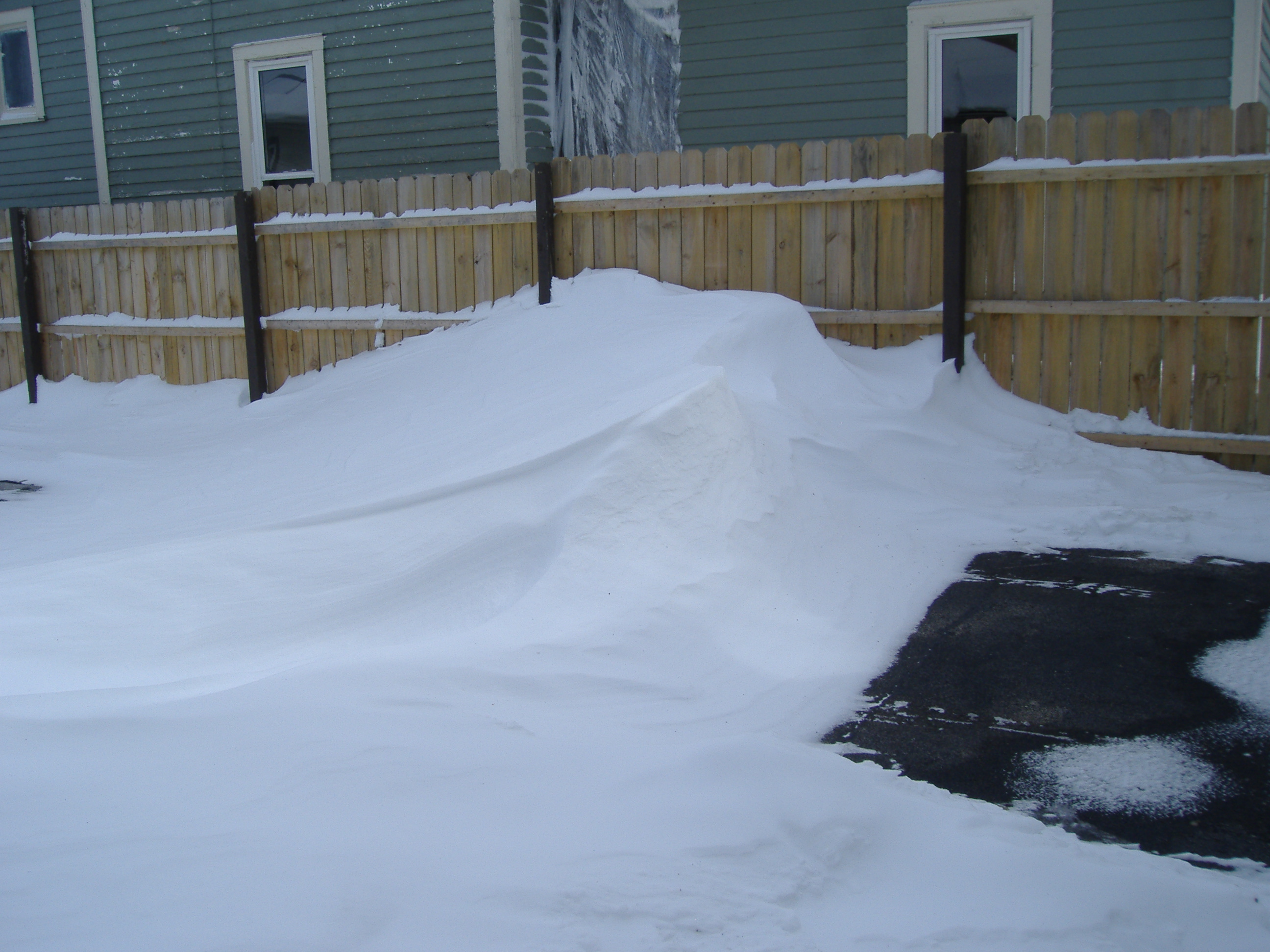
No wonder my kitchen was so dark! That's a six-foot tall fence

When I woke up, the winds had died down quite a bit, but the house seemed very odd. I realized it was because nearly every window was covered with frozen-on snow, obscuring much of the light. I surveyed the damage: officially, we got 20 inches, and I had drifts nearly 4 and 5 feet tall, some next to bare patches of pavement. A piece of my garage roof soffit was lying in the backyard.

The driveway: 4 ft drifts next to bare pavement

But since I was working from home, there wasn’t really a snow day. I went out at lunchtime and began shoveling – after I tunneled to the garage to retrieve my shovel.

I went out for a couple brief spells in the afternoon, thankful I didn’t really need the car until Saturday.

My tunnel, from house to street

Late in the afternoon, I started to dig out the end of the driveway, where it was drifted pretty deep, and finally had a tunnel to the street. My neighbor stopped by with his ATV, to which he had strapped a plow blade. He had a great time, riding up my drifts and then barreling downhill towards the street, pushing mountains of snow as he went. As he plowed, a former neighbor pulled up with his snowblower and asked if I wanted some help. Other neighbors also offered help. (I love this town.)

Luckily, I had no pressing need to take out the trash.

Later, I met up with some neighbors and helped clear the sidewalks of the main street in the neighborhood. Afterwards, we went to the local bar for chili and beer.

So while I didn’t get a traditional snow day, it was still a pretty good day. I even settled in with a mug of tea and pulled out The Long Winter before bed.

But that said, I think I’d be okay if we didn’t get any more snow this winter.

Though it was kind of pretty.

I do love the view over the river.

Communities IRL

When today’s #reverb10 prompt appeared, I thought, “Hey, I wrote this one already!”

And indeed, in September, I wrote about my experience in Finding Community in Elgin, a completely enthralling, exciting development.

But re-reading the prompt (Community. Where have you discovered community, online or otherwise, in 2010? What community would you like to join, create or more deeply connect with in 2011?), I realized that there’s another aspect I completely overlooked.

2010 was truly a social media – and specifically, Twitter – year for me. And while Twitter is indeed part of my job, I’ve started taking the community-building lessons I’ve learned at work and applying them to – gasp – real life.

I joined Twitter groups of Chicago-area runners, and that lead me to DailyMile, a Facebook-like site specifically for athletes. From DailyMile, I’ve made new friends, some of whom I’ve actually met IRL (in real life). It’s such an encouraging, inspiring group that I doubt I would be running at the level I am now without this community.

I also connected with several other Chicago-area marketing people, some of whom turned out to live very near me. And again, meeting them IRL at various events has been enriching, with new ideas and perspectives galore that go well beyond 140 characters.

So that’s my goal for 2011 – continue to take these fantastic Twitter/DailyMile/LinkedIn/other relationships beyond the platform that created them. Because while a virtual community is cool, it can’t beat real life.

This post is part of #Reverb10, a month-long project to reflect on the year nearly gone. Read all my #Reverb10 posts, or learn more.

A New Tradition: Trotting for Turkey

A year ago, I didn’t know that thousands of people wake up early on Thanksgiving morning and run in the cold.  It’s a day designed for sleeping in, unless you’re the one stuck with turkey duty.

But by September of this year, I had heard of the Turkey Trot phenomenon, and  it became a matter of choosing which one to tackle.

Then I learned that the Gifford Park Association, another Elgin neighborhood group, was hosting its first-ever Thanks a Lot Turkey Trot 5k, and my choice was easy.

The forecast began mentioning ominous words like “ice pellets” and “sleet,” but since a couple friends were committed, I was too. I went to the outlet mall yesterday with my parents, and managed to convince them to let me have one of my Christmas presents early. My new waterproof, breathable jacket should carry me through the winter, and today was the first test.

When I woke up, it was still dark, and everything was wet from a steady mist. But at least it was above freezing at 38 degrees. By the time my dear friend Sarah picked me up, the mist had stopped and the wind was picking up. My long sleeve Pumpkin Run shirt paired with my new jacket kept me plenty warm – the wind couldn’t cut through at all, and I actually unzipped the vents about mid-way through the race.

A small crowd assembled in the park, bringing canned goods for the local food pantry. The atmosphere was very laid back, unlike any other race I’ve done. I think a lot of it was the size of the crowd – there were maybe 50 participants? {Ed note: The Courier-News reported there were 111 participants – apparently my crowd estimating abilities need some work)- and the absence of many of the traditional race trappings. There were no bibs or chips, no timing mat, not even an official clock. Instead, as everyone assembled, the fantastic organizer Amanda read off a series of announcements, including something about a problem with a clock, so there was just a guy with a stopwatch.

But for a gloomy, damp holiday morning, the atmosphere felt exactly right. We took off and, without a crowd to keep my pace in check, I started way too fast. I looked down after a quarter mile and was running a 7:40 mile. Whoa, Nelly! I slowed to a brisk-but-comfortable 9:30 pace and enjoyed the course.

I’ll admit I was wary of a course that was two laps – I didn’t want to get lapped! – but the crowd was thin enough it was never an issue. I love the Gifford Park neighborhood (the oldest in Elgin, chock full of interesting, historic homes) and running through it provided an entirely new perspective. We trotted – that’s really the right word – past Channing School and up the steep but mercifully short hill, then around Channing Park and back down the hill and through the center of Gifford Park to began the second lap.

There were an abundance of water stops – essentially three along the way, counting the conveniently placed start/finish line stop at the midpoint – and the volunteers were at every turn so the turns were very clear.

I finished in 29:18, which isn’t great – my 5k PR stands at 28:12 on a very flat course – but given the mood and atmosphere, I was perfectly fine with it. Rather than awards for quickest finishers, those who brought the most canned goods took home prizes, which seemed fitting.

After I finished and grabbed water, I strolled back through the park cheer on everyone else coming in. It was Sarah’s very first 5k, so when I saw her I really cheered, and she joined me to cheer on Cassie a minute later. Post race refreshments included (nearly frozen) bananas, granola bars and Gushers. I would have liked to stick around a while longer, but it was getting colder (and has been all day – the current windchill tonight as I write is just 6 degrees) and people had feasts to prepare. Sarah and I went to find coffee and hot chocolate. Both good downtown shops were closed, so we ended up driving to Dunkin’ Donuts, sharing pumpkin and gingerbread donuts and warming up.

Overall, it was a great local, laid-back race that I would definitely do again. The shirts were cute, and it’s nice to have one with a well-designed logo not clouded by a dozen sponsors.

And I realize how thankful I am for my health, my ability to run, and all the friends, old and new, who make life so great.

Gardening Fail

My first year of vegetable gardening didn’t go quite as planned.

I had lots of early success, but when it came to the fall harvest, I fell sadly short.

So sad... no caprese

I got a handful of tomatoes, but they never got much larger than golf balls. I left them on the vine, hoping they would grow, but most of them shriveled up and died.

I saw four small eggplants, and hoped they would keep growing, but I finally harvested them after the frost and tried to roast them, but they were just too small.

Good thing I wasn't planning on making carrot cake.

Good thing I wasn't planning on making carrot cake.

The carrots? I waited until the tops were 8 inches tall before excitedly pulling them from the ground… and got a handful scrawny little carrot bites.

The beans started off well, but I think I planted them too late, as they like the cooler weather. They wilted and scorched under the July sun.
I had several peppers start, and one got a decent size before falling to the ground, where some animal got to it. (Or perhaps the critter knocked it off the vine? All I know is it was just about ready to pick one day, and on the ground with gnaw marks the next.) But the rest never got very big, despite my waiting. At the end of the season, while removing the last of the tomato cages, I found two decent sized peppers – with gnaw marks. Damn squirrels.

Anything that got much bigger than this got eaten by the local wildlife

The cucumbers and zucchini sprouts did very well on the driveway, but once I transplanted them into the ground, they really didn’t grow much. I had a couple squash blossoms, but no fruit.

Meanwhile, the cherry tomatoes and basil in planters along the driveway did very well, and the zinnias, begonias and nasturtiums out front thrived in their full sunlight.

So what did I do wrong? Plant too late? Reading labels, it sounds like I should have started these plants earlier, like late April or May, especially the cooler weather veggies like beans.

Not enough sun? I watched a couple days, and while the backyard definitely gets far more than the 0 hours of sun it used to, is 4 hours of full sun and another 1-2 of partial sun enough? The tomatoes stretched to reach the sun, but perhaps the lack of solar power stunted their growth.

Do I need to do more than just water and weed? Should I fertilize? Mulch? Use Miracle Gro?

So, gardening friends – help me out. Alternatively – does anyone have a good local CSA they recommend for next season?

Must Everything Go?

This morning, I attended my first estate auction, held at a house just a few blocks away. Built in the 1880s, the house has been vacant since its owner, Bernice, died 7 or 8 years ago. She had grown up in that house, then married and lived there with her husband. They had no children, so after she passed away, it sat, full of antiques and a lifetime’s worth of accumulated stuff.

The online advertisement talked of how rare it is to find a house with its contents so intact, and surveying the rows and rows of tables filled with everything from beautiful antique furniture to the minutiae of life – pots and pans, tablecloths, Christmas ornaments – made me kind of sad.

It took only three hours to auction off an entire lifetime of things. Each of those items had a story behind it, and I’m sure Bernice could have told you that the large platter was a Christmas present from her husband or she wore that broach to her best friend’s wedding. Maybe the books and books of stamps, so lovingly collected over the years, were a hobby shared with her husband. Did she receive the china as a wedding gift?

Even sadder were the photographs. Those were auctioned off in lots, and when interest waned, they started combining boxes, so three boxes of assorted family photographs – for a family whose line has ended – were going for a bid of $10. There was a pair of old photographs of the house itself, dated 1887, that should have stayed with the house, but instead they were bought and carted away.

I know that, with no heirs to speak up for the items, an auction is the logical way to dispose of it all. But I wonder if Bernice could have ever thought that the entire box of mementoes from her career at the Elgin National Watch Company would fetch just $20 from a stranger some 30 years later. And when I got home, and surveyed the items I’ve collected in my travels, I wonder if the silver Turkish coffee set I haggled for in Istanbul or the hand-painted clay puppets from Greece will some day be part of a similar auction.

I never raised my bid card, though I wish I would have on the Lady Elgin pendant watch, gold-filled, that went for $25. And the green Depression glassware was so pretty, but I had no real use for it. A friend won a couple lots of quilts and goofus glass, and gave me a pair of Japanese plates that had been thrown in. They’ll look nice in my built-in china cabinet.

Overall, it was an interesting morning, standing in the pouring rain under umbrellas, watching an entire houseful of items be inspected and carried off. (The mimosas and hot coffee definitely added some joviality to the affair.) I think I’ll go to more auctions in town, if even just to see the old photos of Elgin as it used to be. And maybe I’ll find a watch, or a photo of my house, perched up on the bluff.


Night Owls: Riding the Late Train

Since I’ve started grad school, I’m taking a late train home two nights a week. These trains are a completely different experience than the usual 5:17 express train. Depending on whether I go out with classmates for a drink (which happens the occasional Thursday) or go straight to the train translates to a completely different cast of characters.

Earlier Late Train

Mostly work- and class- weary riders: Overall, this train is pretty quiet, with many people coming from grad classes. These are mostly professionals who look tired. They tend to either zone out with ear phones or frantically work on their laptops, catching up on either work or school, a glazed look on their face.

Drunk middle-aged dude: More common on Thursday nights, there’s inevitably one overly chatty, drunk middle aged guy in a leather jacket, trying to act 15 years younger than he actually is. He chats up the conductors and tries to flirt with some of the women. He tends to slur his words. Often he makes a quick call to a wife, asking her to come pick him up from the station.

Giggling Teenage Girls: I don’t know how high school age girls always manage to be on this train, but maybe they’re actually college freshman. Regardless, there tends to be a group of 5-8 giggling, shrieking girls, taking pictures of each other, texting each other, and excited that they just spent the day in the big city. (These are likely the same people who walk five abreast down the sidewalk at rush hour.) Try to avoid the car they’re sitting in.

Loud Talker: Every train has at least one person who shouts their end of a long, inane, deeply personal cell phone conversation. This is more often a woman, but men are guilty, too. When they start rattling off credit card numbers, I wonder who else is listening.

McDonald’s Eaters: After 7 PM, the closest thing to food at Union Station is McDonald’s. (Unless it’s closed, which has happened twice recently, leaving your late night dining options Mrs. Fields cookies or beer.) I think I’ve finally figured out when to eat what so I’m not ravenous as I hit the train, but inevitably, there’s at least one person who boards with a bag of fresh, hot McDonald’s fries.

Later Train

The later train has all of the above groups, but they tend to be rowdier. There are more drunks and gigglers, and fewer students and office workers. During baseball season, there are also hoards of very drunk sports fans. There’s also usually at least one very annoyed single mom with a gaggle of young children who are cranky at the late hour. She usually either lacks patience for them and yells at them to sit still and shut up, or she ignores them entirely while she talks on the phone.

The later train is worse in many ways because it only has two cars open (versus three on the earlier late train), so there’s less room to hide.

What other characters have you seen on the late night trains?